Warren Buffett Net Worth: How the Oracle of Omaha Built His Fortune
Warren Buffett is one of the most recognizable names in the world of investing, and his enormous fortune has been built over decades of disciplined investing, business ownership, and long-term decision-making. Known as the “Oracle of Omaha,” Buffett became famous for finding valuable businesses, buying them at sensible prices, and holding them for many years.
As of September 2026, Forbes estimates Warren Buffett’s real-time net worth at approximately $146.3 billion, although that figure changes regularly because much of his wealth is connected to Berkshire Hathaway and other investments whose values fluctuate. Forbes also estimated his 2026 Forbes 400 net worth at about $144 billion based on its methodology and valuation date.
Buffett’s wealth story is particularly interesting because he did not build his fortune through an enormous executive salary. Instead, the overwhelming importance of his Berkshire Hathaway ownership and decades of compounded investment returns explain why his net worth became so large.
Warren Buffett Net Worth in 2026
Warren Buffett’s estimated net worth in 2026 is around $146.3 billion, according to Forbes’ September 15, 2026 real-time estimate. Because Buffett’s fortune is heavily tied to investments, his net worth can move by billions of dollars depending on stock-market performance and the value of Berkshire Hathaway’s holdings.
It is important to understand that a billionaire’s net worth is not the same thing as money sitting in a personal bank account. Net worth represents the estimated value of assets minus liabilities. For someone like Buffett, a large portion of that wealth comes from ownership of valuable investments and company shares.
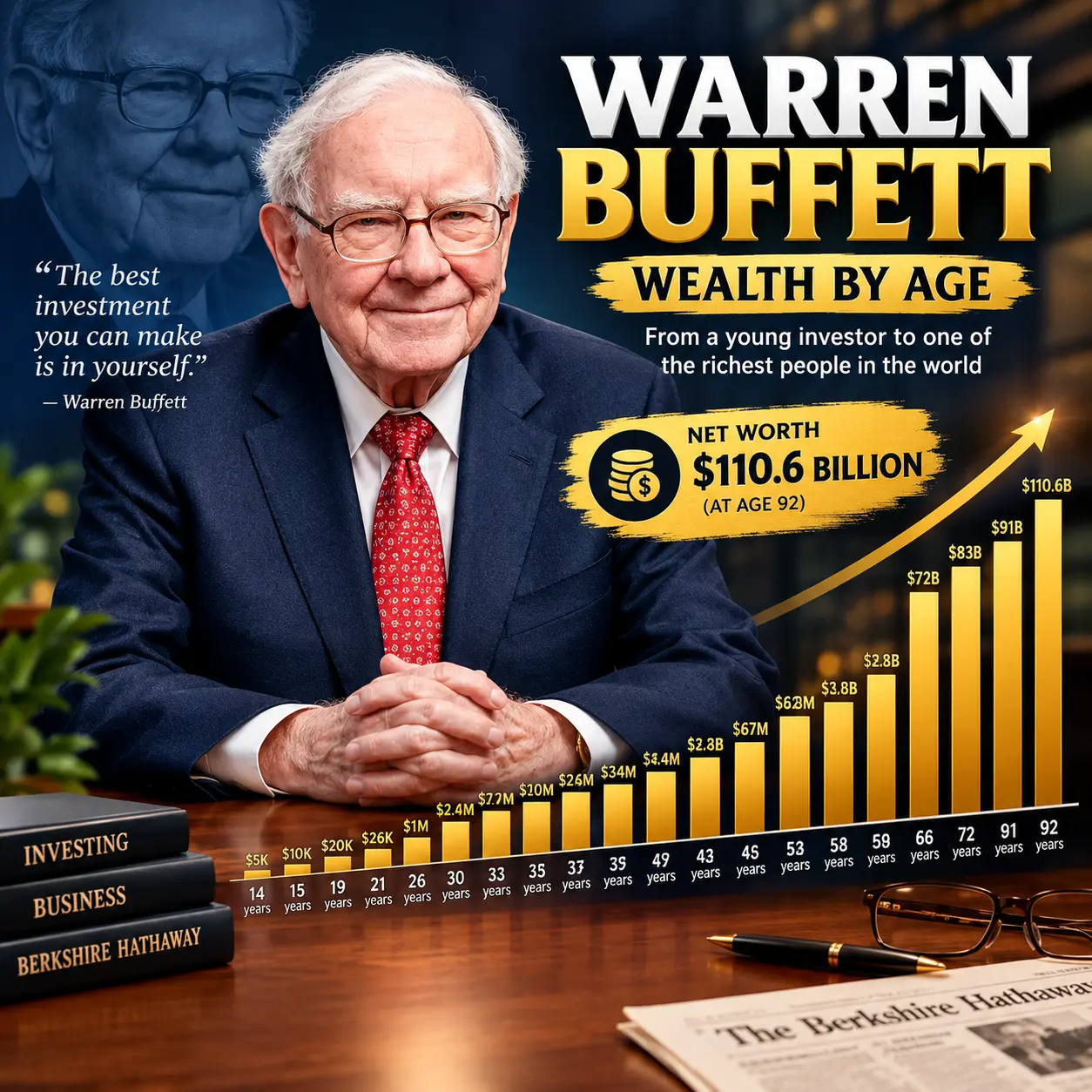
Buffett’s fortune also demonstrates the power of compounding. He started investing at a remarkably young age and eventually became the central figure behind Berkshire Hathaway. Over the decades, the value created through Berkshire’s businesses and investments helped turn relatively modest early investments into an extraordinary fortune.
Warren Buffett Net Worth
| Year/Period | Estimated Net Worth |
|---|---|
| 2000 | Around $25 billion |
| 2010 | Around $47 billion |
| 2020 | Around $88 billion |
| 2024 | More than $140 billion |
| September 2026 | Approximately $146.3 billion |
Historical figures are approximate and can vary depending on the valuation date and source. The September 2026 figure is based on Forbes’ real-time estimate.
Read more details on the official website. celebritynetworth
How Warren Buffett Made His Money
Warren Buffett’s wealth primarily comes from investing rather than receiving a traditional executive paycheck. His name has been closely associated with Berkshire Hathaway for decades, and the company grew from a struggling textile operation into a massive conglomerate with interests across insurance, transportation, energy, manufacturing, retail, and investments.
Buffett’s approach has generally focused on purchasing businesses with durable competitive advantages, strong management, and attractive long-term economics. Rather than constantly trading investments, he became famous for patience and long holding periods.
This strategy helped Buffett benefit from the growth of companies and businesses over many years. The concept is simple on the surface: invest capital, allow good businesses to grow, reinvest the returns, and give compounding enough time to work.
Berkshire Hathaway and Buffett’s Fortune
Berkshire Hathaway is the central piece of Warren Buffett’s financial story. The company owns or controls a wide range of businesses and also maintains a substantial investment portfolio. Its operations have historically included major businesses such as GEICO, BNSF Railway, and Dairy Queen, among many others.
Buffett transformed Berkshire from its earlier textile roots into an investment and operating conglomerate. His philosophy was not simply about buying stocks. He often looked at publicly traded shares as ownership interests in real businesses.
That mindset became one of the defining features of his investing career. Instead of focusing only on whether a stock might rise next week or next month, Buffett emphasized the underlying economics and long-term prospects of the business.
Berkshire’s official 2025 annual report provides detailed financial information about the company’s operations, investments, and financial position.
Warren Buffett’s Salary
One of the most surprising details about Warren Buffett is how small his official salary has been compared with his enormous net worth.
Berkshire Hathaway’s proxy statement reports that Buffett’s annual base salary has been $100,000 for more than 40 years. His compensation structure is very different from that of many large-company CEOs.
For 2024, Buffett’s reported salary was $100,000, with total compensation of $405,111 after including reported security-related compensation. There was no bonus listed for that year.
This is an important distinction when discussing Warren Buffett’s earnings. His personal fortune did not come primarily from his annual salary. Instead, his wealth was accumulated through ownership, investments, and the long-term appreciation of assets.
Warren Buffett’s Investment Philosophy
Buffett’s investing philosophy has become one of the most studied approaches in modern financial history. A central idea is to think like a business owner rather than a short-term trader.
He has repeatedly emphasized the importance of understanding a business before investing in it. Factors such as management quality, competitive advantages, financial strength, and the price paid for an investment all play an important role in his approach.
Another major part of Buffett’s philosophy is patience. Investors often become distracted by short-term market movements, but Buffett’s career demonstrates what can happen when capital is allowed to compound over a very long period.
His investment style also places considerable emphasis on avoiding unnecessary risk. Rather than trying to predict every market movement, Buffett has generally focused on businesses that he believes can remain valuable for many years.
Warren Buffett’s Early Life and Career
Warren Edward Buffett was born in Omaha, Nebraska, in 1930. His interest in business and investing appeared at a very young age. Forbes notes that he purchased his first stock when he was just 11 years old and filed his first tax return at 13.
Buffett eventually studied economics and developed his investment thinking under Benjamin Graham, whose value-investing philosophy strongly influenced him. He later returned to Omaha and began managing investment partnerships.
The experience he gained during those early years helped shape the investment principles that would eventually become associated with Berkshire Hathaway.
His career shows that wealth creation was not an overnight event. Buffett spent decades investing, reinvesting, studying businesses, and allowing his capital to compound.
Warren Buffett’s Philanthropy
Despite having one of the world’s largest personal fortunes, Buffett has committed the overwhelming majority of his wealth to philanthropy.
Forbes reports that Buffett has pledged to give away more than 99% of his wealth and has already donated more than $72 billion, primarily through organizations including the Gates Foundation and foundations connected with his children.
Buffett also helped launch the Giving Pledge with Bill Gates and Melinda French Gates. The initiative encourages billionaires to commit a substantial portion of their fortunes to charitable causes.
His philanthropic plans are an important part of understanding his overall financial legacy because his personal net worth does not represent an intention to preserve the entire fortune for himself or his family.
Warren Buffett’s Leadership Transition
A major change occurred in 2026 as Buffett’s formal leadership role at Berkshire Hathaway evolved.
Berkshire Hathaway’s official 2026 news releases state that on September 18, 2026, Warren E. Buffett became Chairman Emeritus while remaining a director, and Howard G. Buffett was elected chairman.
This followed Buffett’s retirement as Berkshire Hathaway’s CEO at the end of 2025, with Greg Abel taking over the chief executive role. Forbes identifies Buffett as having retired as CEO at the end of 2025.
Even though his executive responsibilities have changed, Buffett remains closely associated with Berkshire Hathaway and its long-term history. His transition marks an important new chapter for a company that he helped shape for decades.
Warren Buffett Earnings & Financial Data
| Financial Category | Warren Buffett |
|---|---|
| Estimated Net Worth, September 2026 | ~$146.3 billion |
| 2026 Forbes 400 Estimate | ~$144 billion |
| Annual Base Salary | $100,000 |
| 2024 Reported Total Compensation | $405,111 |
| 2024 Salary | $100,000 |
| 2024 Bonus | $0 |
| Main Source of Wealth | Berkshire Hathaway & investments |
| Residence | Omaha, Nebraska |
| Philanthropic Commitment | More than 99% of wealth |
| Career | Investor, businessman, Berkshire Hathaway leader |
The net-worth estimate comes from Forbes and represents a valuation at a particular point in time, while compensation figures come from Berkshire Hathaway’s proxy disclosures. Net worth can change substantially as market prices move.
Google E-E-A-T Information
| E-E-A-T Factor | Details |
|---|---|
| Experience | The article discusses Buffett’s decades-long experience as an investor and business leader. |
| Expertise | Financial information is explained using publicly reported Berkshire Hathaway and Forbes data. |
| Authoritativeness | Key financial and career details are based on Forbes and Berkshire Hathaway corporate disclosures. |
| Trustworthiness | Net-worth figures are identified as estimates, and compensation figures are distinguished from investment wealth. |
| Transparency | Market-based net worth is presented as changeable rather than as a permanent fixed amount. |
What Makes Warren Buffett’s Wealth Different?
The most interesting part of Warren Buffett’s financial story is that his wealth is not primarily the result of a huge salary. His reported base compensation remained at $100,000 for decades, which is tiny compared with the size of his fortune.
Instead, Buffett’s financial success illustrates the effect of long-term ownership and compounding. He consistently focused on businesses and investments that could generate value over extended periods rather than attempting to make money from every short-term market movement.
His story also highlights the difference between income and wealth. A person can have a large salary without becoming extremely wealthy, while someone who owns appreciating assets can accumulate substantial wealth even with a relatively modest annual income.
Final Thoughts on Warren Buffett Net Worth
Warren Buffett’s estimated $146.3 billion net worth in 2026 makes him one of the wealthiest people in the world, but the number alone does not explain his financial journey. His fortune was built over many decades through investing, business ownership, patience, and the power of compound growth.
His unusually low executive salary compared with his net worth is another important part of the story. Berkshire Hathaway’s disclosures show that Buffett’s wealth has never depended on a conventional billionaire CEO paycheck. Instead, ownership and investment performance have been far more significant.
As Buffett moves into his next chapter as Chairman Emeritus and remains a Berkshire director, his financial legacy continues to be closely connected with the company he helped transform.
For anyone researching Warren Buffett Net Worth, the biggest lesson is that the headline number represents the result of decades of investing and compounding rather than a single source of annual income. His career remains one of the clearest examples of how long-term capital allocation can shape extraordinary wealth.