
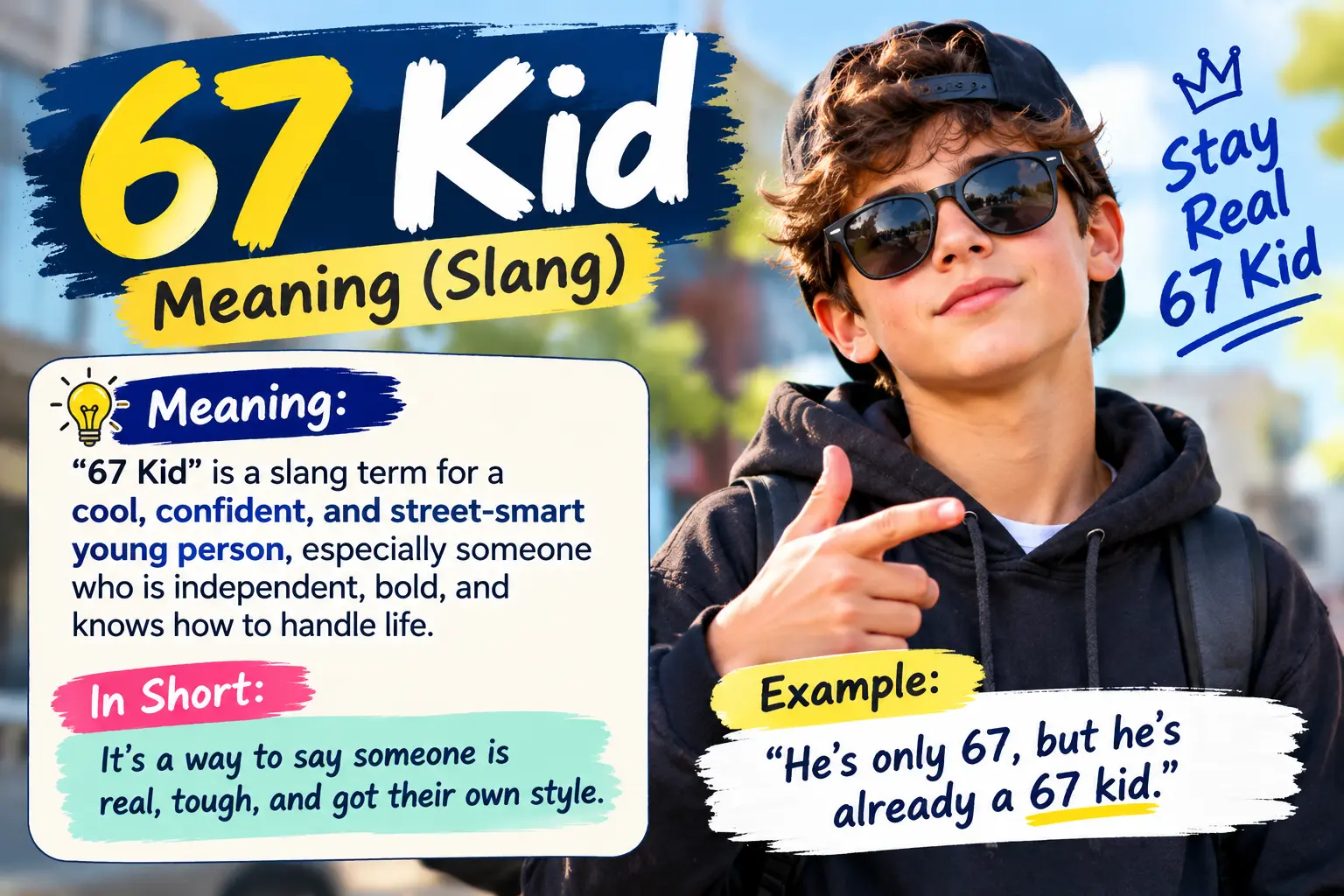
67 Kid Meaning: What Does “67 Kid” Mean and Why Is It Trending?
The phrase “67 kid” has started appearing in online searches and social media conversations, leaving many people wondering what it actually means. At first glance, the term looks like it could refer to a person’s age, a birth year, a nickname, or even a viral internet character. However, like many modern online phrases, its meaning can depend heavily on context.
Internet slang changes quickly. A phrase that seems confusing today can suddenly become popular because of a TikTok video, meme, comment section, song, gaming community, or short-form video trend. The same thing can happen with numbers. A number that originally had a specific meaning can eventually become part of a joke or identity used by younger internet users.
In this article, we will explain what people may mean when they search for “67 kid,” how number-based internet slang develops, why these phrases become viral, and how to understand the expression when you see it online.
What Does “67 Kid” Mean?
The phrase “67 kid” does not have one universally accepted definition. Its meaning can change depending on where you saw it and how it was being used. In some cases, people may simply use “kid” to describe a young person associated with the number 67. In other situations, it can be connected to a meme, nickname, online joke, or viral trend.
This is common with internet language. People often create short expressions that make sense inside a particular online community but sound completely random to someone outside that community. Once the phrase spreads, thousands of people may repeat it without necessarily knowing its original background.
Therefore, it is important not to assume that “67 kid” automatically refers to a particular real person. Without additional context, the phrase should be treated as an internet search term rather than a confirmed identity.
Why Is “67 Kid” Being Searched Online?
One major reason unusual phrases become popular is short-form social media. Platforms built around quick videos can turn an ordinary word, number, or phrase into a recognizable meme within a very short period.
A creator might use a number in a funny caption or repeated phrase. Other users then copy it into their own videos, comments, and posts. Eventually, people who encounter the phrase for the first time begin searching Google or other search engines to understand what everyone is talking about.
This creates a cycle: a phrase becomes popular on social media, people search for its meaning, search volume increases, and more websites begin publishing explanations. The phrase then becomes even easier to discover.
Is “67” Internet Slang?
Numbers are frequently used as slang online. Unlike traditional dictionary words, numerical slang can be highly dependent on a specific community. A number might represent an inside joke, a location, a group, a song reference, a sports reference, or simply a phrase that became popular through repetition.
The interesting thing about number slang is that it often does not look meaningful when someone sees it for the first time. That confusion can actually make the phrase more interesting. People naturally want to know why a particular number is being used.
“67” can therefore appear in different contexts without always having the same meaning. If you see someone using “67” by itself, the surrounding post, video, caption, or comments are important for understanding what the person intended.
Understanding the “Kid” Part of the Phrase
The word “kid” generally refers to a child or young person, but internet users often use it more loosely. Someone may be called a “kid” online simply because they are young, because they are associated with a particular trend, or because the word is part of a nickname.
Online communities also create labels based on memorable events. A person featured in a viral clip may receive a nickname from viewers, even if that nickname was never officially used by the person themselves.
That is why “67 kid” should not automatically be interpreted as the official name of a specific person. It may simply be a descriptive label created or popularized by internet users.
How Internet Nicknames Become Viral
Internet nicknames often start with something very small. A person says a funny phrase, appears in a popular video, participates in a trend, or becomes associated with a particular number. Viewers repeat the reference, and eventually the nickname becomes recognizable.
Once a nickname starts spreading, people often shorten it. Long explanations become abbreviations, numbers replace words, and random phrases become recognizable symbols inside online communities.
The speed of modern social media makes this process even faster. A trend can move from a small group of users to millions of viewers before traditional websites have even explained where it came from.
“67 Kid” and Meme Culture
Meme culture is another important part of understanding unusual phrases such as “67 kid.” Memes are not always designed to be logical. Sometimes the humor comes from repetition, randomness, or the fact that only people familiar with the original joke understand it.
A phrase can become funny simply because everyone keeps saying it. After enough repetition, users may use it ironically even when they have forgotten the original context.
This is one reason searching for the exact meaning of an internet phrase can be difficult. The original meaning may have changed by the time the phrase becomes widely known.
Why Young Internet Users Create Number-Based Trends
Younger social media users tend to communicate with short, memorable expressions. Numbers are particularly useful because they are quick to type and easy to recognize.
A numerical phrase can also create a feeling of belonging. People who understand the reference feel like they are part of the same online community, while newcomers may wonder what they are missing.
This pattern is not new. Every generation has developed its own slang, abbreviations, jokes, and references. The difference today is that social media can spread those expressions globally in hours instead of years.
How to Tell What “67 Kid” Means in a Specific Post
If you encounter the phrase “67 kid” online, the best way to understand it is to examine the context instead of relying on the number alone.
Look at the caption first. The creator may explain what “67” means somewhere in the post. Then check the comments, because viewers often provide background information or explain the original joke.
You can also look at the video, audio, hashtags, and other phrases appearing alongside “67 kid.” These details can reveal whether the term is being used as a nickname, meme, joke, reference, or something completely different.
Quick Facts About “67 Kid”
| Detail | Information |
|---|---|
| Keyword | 67 kid |
| Category | Internet slang / viral phrase |
| Meaning | Context-dependent |
| “67” | May have different meanings depending on the trend or community |
| “Kid” | Usually refers to a young person or online nickname |
| Main Platforms | Social media, short-form video, meme communities |
| Usage | Casual and informal |
| Official Dictionary Definition | No single universal definition |
| Best Way to Understand It | Check the original post and surrounding context |
Is “67 Kid” a Real Person?
One of the most important things to understand about viral search terms is that not every nickname represents an officially recognized person. Internet users frequently create labels for people who appear in videos or become associated with a meme.
If you encounter claims that a particular person is “the 67 kid,” it is better to check the original source before treating that claim as fact. Social media posts can repeat information without confirming where it came from.
This is especially important when a viral nickname becomes popular. Once thousands of accounts repeat the same statement, it can appear authoritative even when the original claim was only a joke or speculation.
The Role of TikTok and Short-Form Content
TikTok and similar short-form platforms have changed how slang spreads. A creator can introduce a phrase to an audience, and viewers can immediately reuse it in their own videos.
Audio clips, captions, hashtags, and comments all contribute to this process. A phrase does not necessarily need a complicated explanation to become popular. Sometimes repetition alone is enough.
This explains why people may suddenly see “67 kid” everywhere and then search for its meaning. The search itself is part of the viral cycle.
Should You Use the Phrase “67 Kid”?
If you understand the context in which the phrase is being used, there is generally nothing unusual about using informal internet slang in a casual conversation. However, slang is not always appropriate for professional or formal communication.
It is also worth remembering that internet phrases can have different meanings in different communities. A joke that is harmless in one group may be confusing somewhere else.
When using a phrase such as “67 kid,” context matters more than the words themselves. If your audience already understands the reference, the phrase may work naturally. If they do not, it may simply create confusion.
Final Thoughts on “67 Kid”
The phrase “67 kid” is a good example of how modern internet language can be confusing, flexible, and highly dependent on context. The number “67” may be connected to a specific trend, joke, nickname, or community, while “kid” can simply describe a young person or become part of an online label.
Rather than assuming that the phrase has one permanent definition, it is better to look at where it appeared and how people around it were using the term. Internet slang can change quickly, and today’s popular phrase may have a completely different meaning tomorrow.
Ultimately, the easiest way to understand “67 kid” is to treat it as a context-driven internet expression. If you see it in a viral video, meme, or comment section, examine the surrounding content first. That usually provides more useful information than the number alone.