Porter Wagoner Net Worth: How Much Was the Country Music Legend Worth?
Porter Wagoner Net Worth was one of the most recognizable figures in classic American country music. Known for his rhinestone suits, distinctive voice, television show, and long association with the Grand Ole Opry, Wagoner built a career that lasted more than five decades. He was also the man who gave Dolly Parton one of her earliest major platforms, making his name permanently connected with one of country music’s biggest stars.
Porter Wagoner Net Worth estimated net worth was around $5 million at the time of his death in 2007, according to Celebrity Net Worth. Other online estimates have placed the figure closer to $10 million, which shows why celebrity net-worth figures should be treated as estimates rather than exact financial records.
His wealth came from several areas, including record sales, live performances, television, songwriting, music collaborations, and property. Unlike many entertainers who became famous for only a short period, Wagoner continued working for decades and remained associated with the Grand Ole Opry until the end of his life.
Porter Wagoner Net Worth at a Glance
| Category | Details |
|---|---|
| Full Name | Porter Wayne Wagoner |
| Born | August 12, 1927 |
| Birthplace | West Plains, Missouri, U.S. |
| Died | October 28, 2007 |
| Age at Death | 80 |
| Profession | Country Singer, Songwriter, Television Personality |
| Estimated Net Worth | About $5 million |
| Alternative Estimates | Around $10 million |
| Main Sources of Wealth | Music, Television, Touring, Songwriting, Real Estate |
| Best Known For | The Porter Wagoner Net Worth Show and Grand Ole Opry |
| Famous Association | Dolly Parton |
| Country Music Hall of Fame | Inducted in 2002 |
Early Life and the Beginning of His Music Career
Porter Wayne Wagoner was born on August 12, 1927, near West Plains, Missouri. He grew up in a rural environment where money was limited, and his early experiences in the Ozarks became part of the personality and storytelling style that later defined his music. His path to stardom was not an overnight success story. He worked ordinary jobs while developing his musical abilities and gradually found opportunities on local radio.
Wagoner’s early performances helped him gain recognition in Missouri. He eventually became a performer on radio and television programs, including Ozark Jubilee. That exposure gave him a much larger audience and helped establish him as a professional country entertainer. His early years also taught him an important lesson about entertainment: a performer needed more than a good voice to build a long-lasting career.
By the mid-1950s, Wagoner had secured a recording contract with RCA and was beginning to establish himself nationally. He joined the Grand Ole Opry in 1957, a major achievement that connected him with one of the most important institutions in country music. The Opry became a central part of his professional identity for the rest of his life.
How Porter Wagoner Net Worth Built His Wealth
Porter Wagoner Net Worth financial success was based on longevity. He was not simply a recording artist who released a few successful songs and disappeared. His career included recordings, television, concerts, appearances, collaborations, and other entertainment activities.
One of his biggest financial opportunities came from television. The Porter Wagoner Net Worth Show began in 1960 and ran for approximately 21 years. The syndicated program became an important country-music television platform and introduced viewers to established performers as well as emerging talent. The show also helped turn Wagoner into a recognizable national personality.
Live performances were another important part of his income. During his peak years, Wagoner was reportedly performing hundreds of concerts annually while simultaneously maintaining his television and Opry commitments. That combination of touring, television exposure, and recording activity gave him multiple sources of professional income instead of relying on record sales alone.
Porter Wagoner and The Porter Wagoner Show
Television played a major role in Wagoner’s career and financial growth. The Porter Wagoner Show became one of the notable syndicated country-music programs of its era. It allowed Wagoner to showcase his own music while bringing other artists into homes across North America.
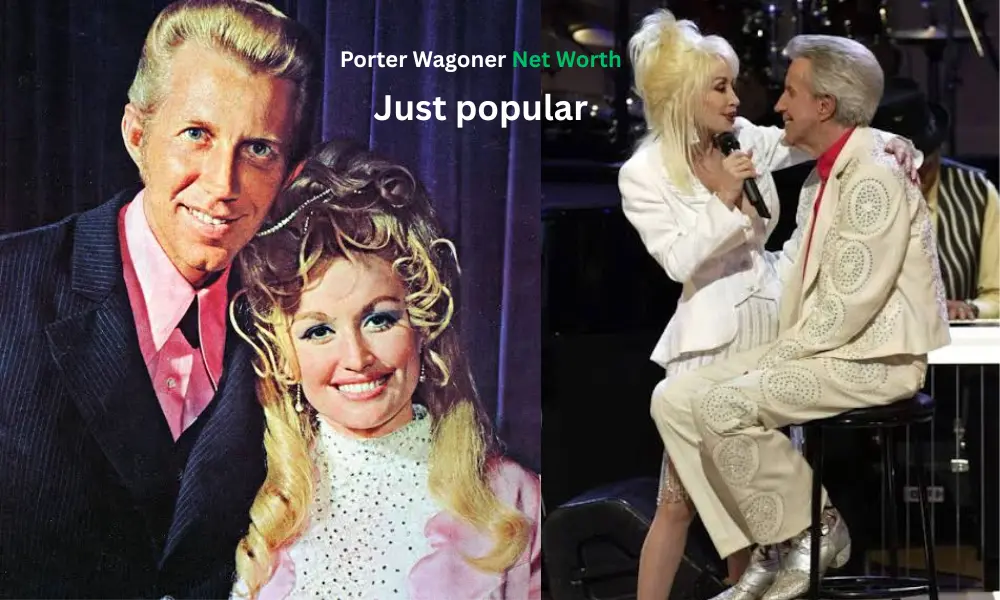
The show became particularly important after Dolly Parton joined the cast in 1967. Parton was still a young performer at the time, and Wagoner gave her a major opportunity to reach a much broader audience. Their professional relationship became one of the most famous partnerships in country music history.
The television program continued until 1981, giving Wagoner more than two decades of consistent exposure. Even after the program ended, the recognition he gained from television helped him maintain his position within the country-music community.
Porter Wagoner and Dolly Parton
Perhaps the most famous chapter of Wagoner’s career was his partnership with Dolly Parton. When Norma Jean left his television show in 1967, Wagoner selected Parton as her replacement. Their professional relationship quickly developed into a successful musical partnership.
Wagoner and Parton recorded numerous duets together. Their songs became successful on the country charts, and the pair won the Country Music Association’s Vocal Duo of the Year award in both 1970 and 1971. Their partnership was commercially successful as well as artistically important.
Parton eventually decided to leave Wagoner’s show and pursue her own career. Their separation was complicated and led to legal disputes. However, their relationship eventually improved, and the two reconciled. Parton’s famous song “I Will Always Love You” was written as a farewell to Wagoner and their professional partnership.
Importantly, Wagoner did not receive the enormous publishing fortune that Dolly Parton later earned from the song. Parton retained ownership of her song’s publishing, and the song eventually became one of the most financially successful compositions in popular music history after Whitney Houston recorded it for The Bodyguard.
Earnings & Financial Data
Because Wagoner died in 2007, there is no reliable public record showing a precise annual salary throughout his career. The commonly reported net-worth estimates are therefore best viewed as approximate figures.
| Financial Category | Estimated/Reported Information |
|---|---|
| Estimated Net Worth at Death | About $5 million |
| Other Published Estimates | Around $10 million |
| Television Income | Significant source during 1960–1981 |
| Music & Recording Income | Major long-term income source |
| Concert & Touring Income | Important during peak career years |
| Real Estate | Part of his later financial assets |
| Nashville Property Purchase | Reported purchase price of $201,000 in 1985 |
| Nashville Property Sale | Heirs sold the property for $1.7 million in 2025 |
| Exact Annual Salary | Not publicly documented |
| Exact Estate Value | Not publicly documented |
The most conservative widely cited figure is approximately $5 million. Celebrity Net Worth reports that amount for Wagoner at the time of his death. Other websites have published estimates of $10 million or more, so it is more responsible to present a range rather than claim that one figure is unquestionably correct.
His real-estate holdings provide another interesting example of how his assets could have appreciated over time. Celebrity Net Worth reports that Wagoner purchased a 2.5-acre Nashville property for $201,000 in 1985, and his heirs later sold the property for $1.7 million in 2025. That later sale does not mean the entire increase represented Wagoner’s personal profit, but it demonstrates that real estate formed part of the family’s long-term asset picture.
Porter Wagoner’s Music Career and Hit Songs
Wagoner enjoyed a substantial recording career. He became known for songs such as “A Satisfied Mind,” “Misery Loves Company,” “Skid Row Joe,” “Carroll County Accident,” and “Green, Green Grass of Home.” His music combined traditional country storytelling with a highly recognizable performance style.
His success was not limited to solo recordings. Wagoner also worked in gospel music and recorded with the Blackwood Brothers. Those recordings contributed to his reputation as a versatile performer rather than simply a country-pop entertainer.
His recording career continued for many years, although the commercial landscape of country music changed considerably over time. By the 1980s, his mainstream popularity had declined, but he continued finding ways to remain involved in entertainment and the Opry community.
Porter Wagoner’s Later Career
After The Porter Wagoner Show ended in 1981, Wagoner continued working rather than disappearing from public life. He appeared in the 1982 Clint Eastwood film Honkytonk Man and remained involved in music-related projects.
He also became involved with Opry Backstage during the 1990s and continued appearing at the Grand Ole Opry. The Country Music Hall of Fame notes that Wagoner became something of an unofficial spokesperson for the Opry after Roy Acuff’s death in 1992.
Wagoner’s later years produced an unexpected career revival. In 2007, Marty Stuart produced Wagonmaster, an album that received strong reviews and introduced Wagoner’s music to younger listeners. He even opened for The White Stripes at Madison Square Garden, showing that his influence extended beyond traditional country audiences.
Google E-E-A-T Table
| E-E-A-T Factor | How This Article Supports It |
|---|---|
| Experience | Covers Wagoner’s career, television work, music, touring, and later-life activities. |
| Expertise | Uses established biographical and music-industry sources to explain his career and finances. |
| Authoritativeness | References the Grand Ole Opry and Country Music Hall of Fame for major career facts. |
| Trustworthiness | Clearly distinguishes reported net-worth estimates from verified historical facts. |
| Transparency | Notes that exact annual earnings and estate values were not publicly documented. |
Porter Wagoner’s Awards and Legacy
Wagoner’s contribution to country music eventually received formal recognition. In 2002, he was inducted into the Country Music Hall of Fame, confirming his importance to the genre.
His legacy also includes his long membership in the Grand Ole Opry. Wagoner joined the Opry in 1957 and celebrated 50 years as a member in 2007. He remained connected with the institution until his death later that year.
His distinctive appearance also became part of his legacy. His blond pompadour and extravagant rhinestone suits made him instantly recognizable. The Opry notes that many of his famous suits were created by Nudie Cohn, whose designs helped shape the visual culture of country music.
Porter Wagoner’s Personal Life and Death
Wagoner was married twice and had three children. His personal life was generally less central to his public image than his music and television career. His professional life, particularly his association with Dolly Parton and the Grand Ole Opry, remained the defining story of his public identity.
In 2006, Wagoner suffered a serious intestinal aneurysm but recovered enough to return to performing. His comeback continued into 2007, when he released Wagonmaster and appeared at major events.
Wagoner died on October 28, 2007, at the age of 80 after battling lung cancer. His death marked the end of a career that had lasted more than 50 years.
What Was Porter Wagoner’s Net Worth at the Time of His Death?
The most frequently cited estimate from Celebrity Net Worth puts Porter Wagoner’s net worth at approximately $5 million in 2007. Other sources have estimated his wealth at around $10 million or higher. Because there is no complete publicly available accounting of his estate, investments, debts, royalties, and personal assets, the exact number cannot be confirmed with certainty.
A reasonable way to understand his financial success is to look beyond the headline number. Wagoner spent decades earning money from recordings, television, touring, and entertainment. His long-running TV show provided a particularly valuable platform, while his Grand Ole Opry career gave him a professional home for half a century.
His financial legacy also demonstrates how entertainment wealth can be built gradually. Wagoner did not need a modern blockbuster franchise or a massive social-media following. He built his fortune through decades of consistent work, recognizable branding, music, television, and business decisions.
Frequently Asked Questions About Porter Wagoner Net Worth
What was Porter Wagoner’s net worth?
Porter Wagoner’s net worth was estimated at approximately $5 million at the time of his death in 2007. Some other sources have reported estimates around $10 million, so the precise figure remains uncertain.
How did Porter Wagoner make his money?
His main sources of income included country music recordings, television, concerts, touring, songwriting, and other entertainment activities. His long-running syndicated television program was particularly important to his career.
Was Porter Wagoner richer than Dolly Parton?
No. Dolly Parton’s later business and music career became vastly more financially successful. Her ownership of songwriting and publishing rights, business ventures, entertainment projects, and other investments eventually created a fortune many times larger than Wagoner’s estimated wealth.
Did Porter Wagoner discover Dolly Parton?
Wagoner played a major role in launching Parton’s national career. He hired her for his television show in 1967 and partnered with her professionally and musically for several years.
Did Porter Wagoner own “I Will Always Love You”?
Dolly Parton wrote “I Will Always Love You” as a farewell connected to her professional separation from Wagoner. The song became Parton’s intellectual property and later generated enormous royalties through other recordings, especially Whitney Houston’s version.
When did Porter Wagoner die?
Porter Wagoner died on October 28, 2007, at the age of 80. He died from lung cancer.
Was Porter Wagoner in the Country Music Hall of Fame?
Yes. He was inducted into the Country Music Hall of Fame in 2002.
How long was Porter Wagoner a member of the Grand Ole Opry?
Wagoner joined the Grand Ole Opry in 1957 and remained an Opry member until his death in 2007, giving him approximately 50 years of membership.
Final Thoughts on Porter Wagoner Net Worth
Porter Wagoner’s estimated $5 million net worth represents only one part of his legacy. His real achievement was building a career that survived changing musical trends, evolving television audiences, and decades of competition in Nashville.
He became a country-music star, television host, businessman, mentor, and Grand Ole Opry institution. His partnership with Dolly Parton became one of the most important professional relationships in country music, while his own recordings and performances established him as a respected artist in his own right.
Although exact financial records are not publicly available, the available estimates suggest that Wagoner accumulated substantial wealth through a remarkably long career. More importantly, his influence continues through the music he recorded, the performers he supported, and the role he played in the history of country music. His name remains closely tied to the golden era of Nashville entertainment and to the story of one of America’s most enduring musical traditions.