
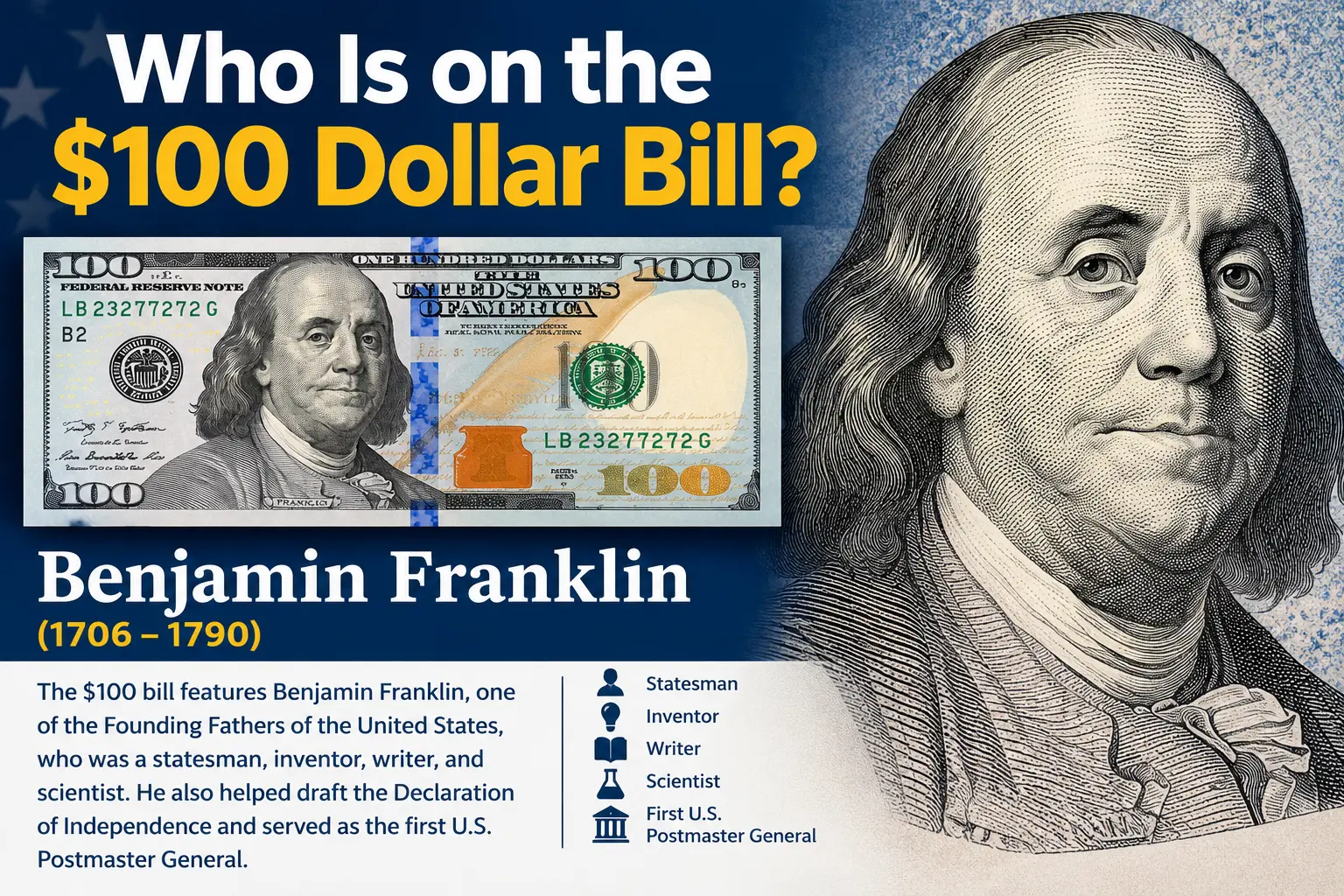
Who Is on the $100 Dollar Bill? Meet Benjamin Franklin
Who Is on the $100 Dollar Bill is one of the most recognizable banknotes in the world, but have you ever wondered who appears on the front of it? The answer is Benjamin Franklin, one of the most influential figures in American history. He was a scientist, inventor, writer, printer, diplomat, and political thinker who played an important role in the founding of the United States.
Interestingly, Franklin was never a president of the United States. Unlike the people featured on many other American banknotes, he earned his place through his contributions to science, public service, diplomacy, and the American independence movement.
The $100 bill is also known as a hundred-dollar note or a Benjamin. Its design contains several historical details and security features that make it different from other denominations. Understanding the person behind the portrait makes the bill more interesting than simply a piece of money.
In this article, we will explore who is on the $100 dollar bill, why Benjamin Franklin was selected, what appears on both sides of the note, and several interesting facts about his life and legacy.
Who Is on the $100 Dollar Bill?
Benjamin Franklin is the person pictured on the front of the modern American $100 bill. His portrait appears on the left side of the note, making him easy to recognize. The design also includes the number 100, official government seals, serial numbers, and security features intended to help people identify genuine currency.
Franklin was born on January 17, 1706, in Boston, Massachusetts, which was then part of British America. He grew up in a large family and received limited formal schooling. Despite these early limitations, he developed a remarkable interest in reading, writing, science, and practical problem-solving.
Throughout his life, Franklin worked in several different fields. He became a successful printer and publisher, conducted important electrical experiments, helped establish public institutions, and represented American interests overseas. His achievements made him one of the most respected figures of the American founding era.
According to the U.S. Bureau of Engraving and Printing, the $100 note features Franklin on the front and Independence Hall on the back. These images connect the currency to the country’s political and historical development.
Who Was Benjamin Franklin?
Benjamin Franklin was a founding figure of the United States whose influence extended far beyond politics. He was known for his curiosity, practical intelligence, and ability to turn ideas into useful inventions and public projects. His work helped shape American civic life during the eighteenth century.
Franklin began his career in the printing business. He eventually became a successful publisher and gained recognition through his writing, including Poor Richard’s Almanack. This publication offered practical advice, observations, and memorable sayings that helped establish his reputation as an influential writer.
His interests were not limited to business and literature. Franklin also studied electricity, investigated natural phenomena, and experimented with inventions. His scientific work earned international recognition, and he became an important figure in the exchange of scientific knowledge during the Enlightenment.
Franklin also believed that education, libraries, and public institutions could improve society. He helped establish organizations and initiatives that encouraged learning and community development. These efforts contributed to his reputation as someone who combined personal achievement with public service.
Why Is Benjamin Franklin on the $100 Bill?
Benjamin Franklin appears on the $100 bill because of his lasting contributions to the development of the United States. He helped advance the cause of American independence, participated in important political discussions, and represented the emerging nation in diplomatic negotiations.
One of his most important achievements was signing the Declaration of Independence in 1776. This document announced that the American colonies considered themselves independent from Great Britain. Franklin’s involvement placed him among the key figures associated with the founding of the country.
Franklin also played a major diplomatic role during the American Revolution. His work in France helped secure support for the American cause, including an important alliance with France. This relationship provided valuable military and financial assistance during the struggle for independence.
His selection for the $100 bill also highlights a broader point about American currency: the individuals featured on banknotes do not all need to have served as presidents. Franklin’s contributions as a statesman, diplomat, inventor, and public intellectual made him a suitable choice for one of the country’s most recognizable denominations.
Was Benjamin Franklin Ever President of the United States?
No, Benjamin Franklin was never president of the United States. This is one of the most common questions people ask when they discover his portrait on the $100 bill.
Franklin lived before the American presidency developed into the office familiar today. He died on April 17, 1790, after George Washington had become the first president under the U.S. Constitution. Franklin was an important political leader, but he held different responsibilities throughout his career.
He served in the Second Continental Congress, participated in the drafting and signing of foundational American documents, and helped negotiate international agreements. He also took part in the Constitutional Convention of 1787, where delegates debated and developed the framework of the U.S. Constitution.
Franklin’s position on the $100 bill demonstrates that American history includes many influential people beyond its presidents. His achievements in diplomacy, science, publishing, and public service helped shape the country during its formative years.
What Is on the Front of the $100 Bill?
The front of the modern $100 bill features Benjamin Franklin’s portrait as its central historical image. The note also includes the words “Federal Reserve Note,” the denomination, serial numbers, and seals associated with the U.S. financial system.
One of the most noticeable features is the blue three-dimensional security ribbon. It contains images of bells and the number 100 that appear to move or change when the note is tilted. The ribbon is woven into the paper rather than simply printed on its surface.
Another feature is the color-shifting bell in the inkwell. When the note is tilted, the bell changes from copper to green. This effect is intended to help people distinguish genuine currency from counterfeits.
The front also contains a watermark of Benjamin Franklin that becomes visible when the bill is held up to light. Additional security details include an embedded security thread, microprinting, and raised printing. Together, these features make the modern $100 bill more difficult to reproduce convincingly.
What Is on the Back of the $100 Bill?
The back of the modern $100 bill features Independence Hall in Philadelphia, Pennsylvania. This historic building is closely associated with the founding of the United States and the development of its early government.
Independence Hall is especially important because the Declaration of Independence was adopted there in 1776. The U.S. Constitution was also debated and signed there in 1787. Featuring the building on American currency connects the bill to two major events in the nation’s political history.
The back of the note also displays a large gold-colored numeral 100. This helps people quickly identify the denomination and provides an additional visual aid for people with certain visual impairments.
The combination of Independence Hall and the modern security design gives the note both historical meaning and practical value. While the front honors an influential individual, the reverse highlights a place associated with the creation of the American political system.
When Did Benjamin Franklin First Appear on the $100 Bill?
Benjamin Franklin’s portrait became associated with the $100 Federal Reserve note in 1914, when the Federal Reserve began issuing its own banknotes. However, the history of American $100 currency goes back further, and earlier notes did not all use the same design or portrait.
Over time, the appearance of American banknotes changed as the government introduced standardized designs and improved security measures. The modern size and general arrangement of U.S. paper currency were established through design changes introduced in 1929.
The $100 bill underwent significant redesigns during the twentieth century. In 1996, a new design introduced additional anti-counterfeiting features, including a watermark and security thread. Further improvements were made in subsequent years.
The current modern design entered circulation in 2013. It introduced the blue three-dimensional security ribbon and the color-shifting bell in the inkwell. These features reflect the continuing effort to make American currency easier to authenticate and harder to counterfeit.
Interesting Facts About Benjamin Franklin and the $100 Bill
Benjamin Franklin’s appearance on the $100 bill is only one part of his remarkable story. Several facts about his life and the note itself help explain why the design remains so recognizable.
First, Franklin was a successful printer and publisher before becoming internationally known for his political and scientific achievements. His career demonstrates how a person could influence public life through business, writing, research, and civic involvement.
Second, Franklin is often associated with experiments involving electricity. His scientific investigations helped advance understanding of electrical phenomena, although his work was only one part of the broader scientific developments of his time. He also contributed to practical inventions and public improvements.
Third, the $100 bill features a historical building on its reverse rather than another person’s portrait. Independence Hall serves as a visual reminder of the political events that helped establish the United States.
Finally, the modern $100 bill includes several features that can be checked without specialized equipment. People can feel its raised printing, inspect its blue security ribbon, and look for Franklin’s watermark when holding the note up to light. These details are especially useful for learning how to recognize genuine currency.
Google E-E-A-T
Google E-E-A-T stands for Experience, Expertise, Authoritativeness, and Trustworthiness. These principles help explain the qualities that can make informational content more useful and credible. They are not a guarantee of search rankings, and a table alone does not establish that an article meets Google’s quality expectations.
| E-E-A-T Element | How This Article Addresses It |
|---|---|
| Experience | Explains recognizable features of the $100 bill in practical terms. |
| Expertise | Describes Benjamin Franklin’s historical, scientific, and diplomatic contributions. |
| Authoritativeness | Uses official U.S. currency and government historical information as reference points. |
| Trustworthiness | Distinguishes established historical facts from general explanations and avoids claiming Franklin was president. |
For a published article, the website editor should verify the information against primary sources and add relevant references where appropriate. Clear authorship, accurate historical details, and regular updates can also help readers evaluate the credibility of the content.
$100 Dollar Bill: Quick Facts and Data Table
The following table summarizes the most important facts about the American $100 bill and the person featured on it.
| Detail | Information |
|---|---|
| Featured person | Benjamin Franklin |
| Date of birth | January 17, 1706 |
| Date of death | April 17, 1790 |
| Birthplace | Boston, Massachusetts |
| Was he a U.S. president? | No |
| Main historical roles | Statesman, diplomat, inventor, writer, and printer |
| Front of the bill | Benjamin Franklin’s portrait |
| Back of the bill | Independence Hall |
| Modern design issued | 2013 |
| Currency | United States dollar |
| Face value | 100 U.S. dollars |
| Major security features | Blue security ribbon, watermark, security thread, and color-shifting ink |
These facts provide a quick overview for readers who want the essential information without reading the entire article. The modern design and its security features are documented by the U.S. Currency Education Program and the Bureau of Engraving and Printing.
Frequently Asked Questions
Who is on the $100 dollar bill?
Benjamin Franklin appears on the front of the modern U.S. $100 bill. He was a founding figure of the United States known for his work in science, diplomacy, publishing, and public service.
Was Benjamin Franklin a president?
No. Franklin never served as president of the United States. He was an influential statesman who helped shape the country’s founding and diplomatic relationships.
What building is on the back of the $100 bill?
Independence Hall in Philadelphia appears on the back of the modern $100 bill. The building is associated with the adoption of the Declaration of Independence and the signing of the U.S. Constitution.
Why is Benjamin Franklin on American money?
Franklin is honored for his contributions to American independence, diplomacy, science, and civic life. His achievements made him one of the most influential figures of the nation’s founding era.
When was the modern $100 bill introduced?
The current redesigned $100 note entered circulation in 2013. Its updated design includes a blue three-dimensional security ribbon and a color-shifting bell in the inkwell.
Is every old $100 bill still valid?
U.S. currency remains legal tender regardless of when it was issued, according to the Bureau of Engraving and Printing. Older designs may look different from modern notes, but an older appearance alone does not make a genuine U.S. bill invalid.
Conclusion
So, who is on the $100 dollar bill? The answer is Benjamin Franklin, a remarkable American statesman, inventor, writer, scientist, and diplomat. Although he never became president, his contributions to American independence and public life earned him a lasting place in the nation’s history.
The $100 bill also tells a story through its design. Franklin’s portrait represents an influential individual, while Independence Hall on the reverse recalls the events that helped establish the United States. Modern security features add another layer of interest by showing how currency design has evolved over time.
The next time you see a $100 bill, you will know that its portrait represents much more than money. It honors a person whose ideas, achievements, and public service helped shape the early United States.