Ditto Meaning: Definition, Examples, Pronunciation, and How to Use It
If you have come across the word “Ditto Meaning” in a conversation, message, book, or social media post, you may have wondered exactly what it means. The word is short and simple, but it can be used in a few different ways depending on the situation. Understanding those uses makes it much easier to recognize what someone means when they say “ditto.”
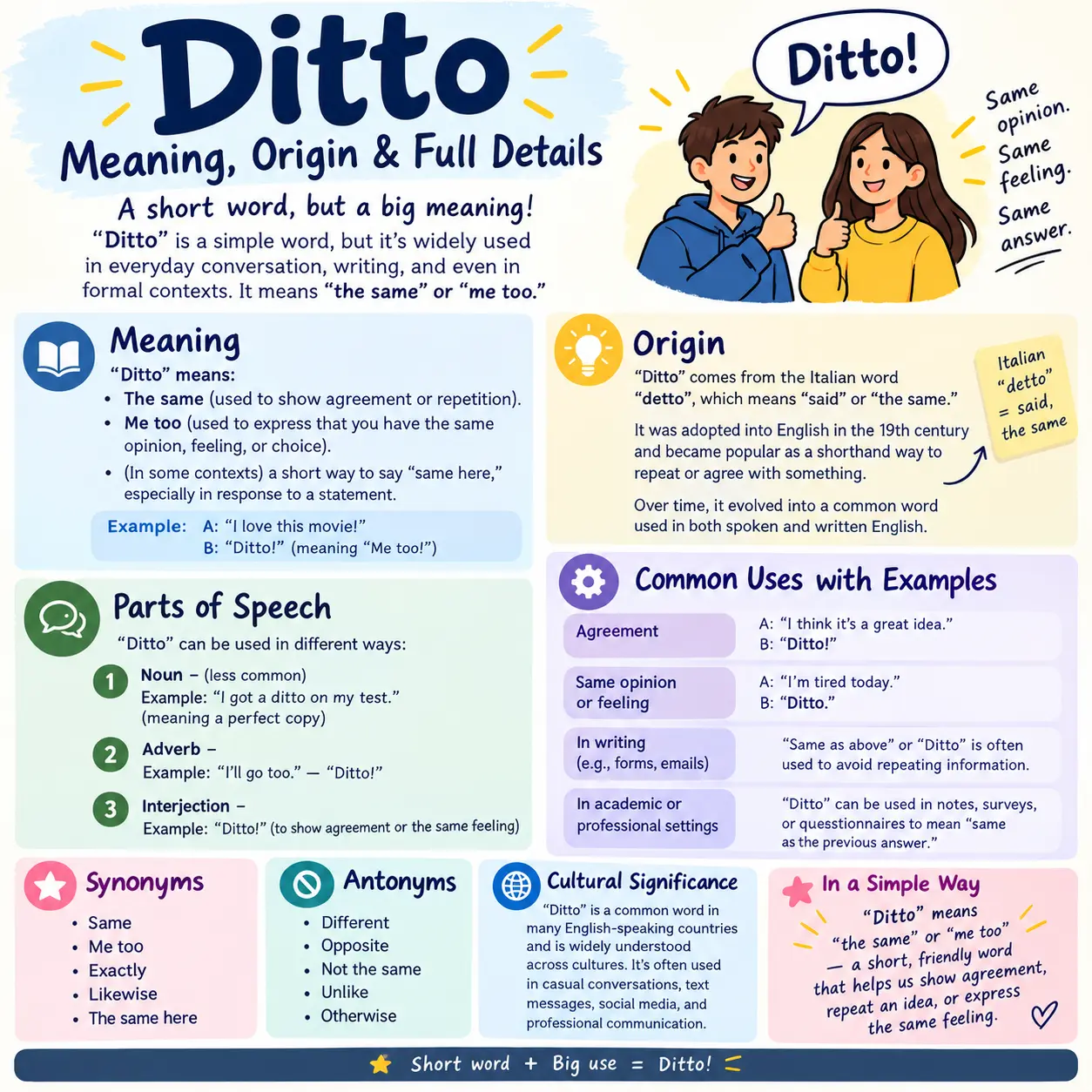
The basic ditto meaning is “the same” or “as previously stated.” In everyday conversation, people often use it when they agree with something someone else has just said. For example, if one person says, “I love this movie,” another person can simply reply, “Ditto.” In that situation, “ditto” means “I feel the same way” or “I agree.” Cambridge Dictionary describes this conversational use as agreeing with something that has just been said or avoiding repetition.
The word can also be used when something previously mentioned is repeated without saying the entire phrase again. This makes “ditto” particularly useful in writing, lists, notes, and informal communication. Although it may sound modern because it is common in casual speech and online conversations, the word has actually been used in English for centuries.
What Does Ditto Mean?
The simplest definition of ditto is “the same as what was mentioned before.” It can refer to an opinion, statement, action, description, or other piece of information that has already been given. Instead of repeating the same words, a speaker or writer can use “ditto” to indicate that the previous information applies again.
For example, imagine someone says, “I am tired after working all day.” If another person responds, “Ditto,” they are saying that they are tired too. The second person does not need to repeat the complete sentence because “ditto” communicates the same idea in a single word.
The word is also commonly used as an informal way of showing agreement. Oxford describes this use as replacing a particular word or phrase to avoid repetition and also notes that it can be used to show that someone agrees or feels the same way. This is why you may see “ditto” in everyday conversations, text messages, comments, and informal writing.
Ditto Meaning in Simple English
In very simple English, ditto means “same” or “me too.” The exact interpretation depends on the sentence in which it appears. When someone uses it as a response to another person’s opinion, it usually means “I agree” or “I feel the same.”
For example, consider this short conversation:
Person A: “I really want to visit London.”
Person B: “Ditto.”
Here, Person B is saying, “I also really want to visit London.” The word replaces the longer statement and makes the response quick and natural.
There is another common situation where “ditto” means that something should be repeated. Suppose a list says “John Smith” in one row and the next row uses a ditto mark to indicate that the same name applies. In this context, the meaning is closer to “same as above.” Dictionaries recognize this use of a ditto mark as a symbol used to avoid writing the same word or phrase again.
How Do You Pronounce Ditto?
The word ditto is generally pronounced “DIT-oh.” In British English, dictionaries give the pronunciation approximately as /ˈdɪtəʊ/, while American English is commonly represented as /ˈdɪt̬oʊ/.
The first part sounds like “dit,” with a short vowel sound similar to the vowel in “sit.” The second part sounds like “oh.” Putting the two parts together gives you “DIT-oh.”
Pronunciation is straightforward because the word has only two syllables. If you are learning English, saying it naturally is more important than trying to exaggerate either syllable. In ordinary conversation, it is usually pronounced quickly and casually.
Examples of Ditto in Everyday Conversation
One of the easiest ways to understand the ditto meaning is to look at real conversational situations. Imagine a friend says, “I am exhausted today.” You might respond, “Ditto.” Your response means that you are exhausted as well.
Another example could be a discussion about food. One person might say, “Pizza is my favorite food.” If another person completely agrees, they could say, “Ditto.” In this case, “ditto” works almost like “same here.” It avoids unnecessary repetition while still making the meaning clear.
The word can also be used after a statement rather than as a standalone response. For example, someone might write, “The service was slow, and the food was disappointing. Ditto the atmosphere.” Here, “ditto” indicates that the same negative description applies to the atmosphere. Oxford gives similar examples where “ditto” replaces a previously mentioned description.
Ditto as a Way to Say “Me Too”
In casual conversation, one of the most recognizable uses of “ditto” is as a replacement for “me too.” This is especially common when two people share the same opinion, feeling, preference, or experience.
For example:
Person A: “I could really use a vacation.”
Person B: “Ditto.”
The second person is not simply repeating the first sentence. They are confirming that they have the same feeling. In this sense, “ditto” is short, informal, and conversational.
Another example is:
Person A: “I don’t like waking up early.”
Person B: “Ditto.”
Here, the response means, “I don’t like waking up early either.” Cambridge Dictionary specifically identifies this type of use as agreeing with something that has just been said.
Ditto as “Same as Above”
The meaning of ditto is not limited to conversation. It has traditionally been used in lists, tables, records, and other written material to indicate that information should be repeated.
For example, a simple table might contain:
| Item | Color |
|---|---|
| Shirt | Blue |
| Jacket | Ditto |
| Shoes | Black |
In this example, “Ditto” means that the jacket has the same color as the item immediately above it: blue.
A special symbol can also be used for this purpose. The traditional ditto mark is associated with quotation-like marks or the symbol 〃, depending on the writing system and context. Oxford identifies the symbol 〃 with the noun “ditto,” while Cambridge describes a ditto mark as a symbol used to indicate that the same information should be repeated.
The Origin of the Word Ditto
The history of “ditto” is older than many people realize. Oxford traces the word to the Tuscan dialect, where it came from Italian detto, meaning “said,” and ultimately from the Latin dictus, also meaning “said.” Oxford places its origin in the early 17th century.
The historical development makes sense because the word was originally connected with something that had already been said or stated. Over time, “ditto” developed into a convenient way of referring back to previously mentioned information.
The American Heritage Dictionary also explains that “ditto” entered English in the 17th century and developed meanings associated with something stated before, a duplicate, and the marks used to indicate repetition. This long history explains why the word can function both as a conversational expression and as a notation for repeated information.
Is Ditto Formal or Informal?
Whether “ditto” is appropriate depends on the context. In everyday speech, it is perfectly natural and is often used casually to mean “same” or “I agree.”
For example, saying “I am hungry” followed by “Ditto” sounds normal in a friendly conversation. It is concise and easy to understand. The same applies to informal text messages and online conversations.
However, in highly formal writing, it can sometimes be clearer to repeat the actual information instead of relying on “ditto.” Official documents, academic writing, contracts, and professional reports often prioritize precision. In those settings, repeating the exact wording can prevent ambiguity. The word itself is not inherently incorrect, but the appropriate choice depends on the style and purpose of the writing.
Ditto vs. Same: What Is the Difference?
“Ditto” and “same” can have similar meanings, but they are not always interchangeable in exactly the same way. “Same” is an extremely broad English word that can describe identical characteristics, people, objects, ideas, or situations.
“Ditto,” on the other hand, usually points backward to something that has already been stated. It carries the idea of repeating or agreeing with previous information.
For example, if someone asks, “Do you want the same drink?” the word “same” describes the drink being requested. If someone says, “I want coffee,” and you reply, “Ditto,” you are referring back to the previous statement and indicating that you want coffee as well.
This backward-reference function is one of the most important parts of understanding the ditto meaning. It is not simply another random synonym for “same”; it usually depends on something previously mentioned.
Common Synonyms for Ditto
Depending on the context, several expressions can communicate a similar idea. Common alternatives include same here, me too, likewise, as above, the same, and I agree.
“Same here” is especially close to the conversational use of “ditto.” For example, “I love this song” followed by “Same here” has almost the same meaning as “I love this song” followed by “Ditto.”
“Likewise” can also express a similar idea, although it can sound slightly more formal. “As above” is more appropriate when referring to written information rather than expressing an opinion in conversation.
The best alternative depends on the situation. If you are chatting casually with a friend, “same here” or “me too” may sound very natural. If you are referring to repeated information in a list, “same as above” may be clearer.
How to Use Ditto Correctly in a Sentence
Using “ditto” correctly is fairly easy once you understand its relationship with previously stated information. As a standalone response, it can follow a statement that you agree with.
For example:I love summer. Ditto. It can also appear after a sentence to indicate that the same description applies to another subject:
“The hotel was expensive, and the restaurant was ditto.”
However, not every sentence requires “ditto.” The word works best when the reader or listener can easily identify what previous information is being repeated. If there is no clear reference, “ditto” can become confusing.
In modern communication, the conversational meaning is probably the one most people encounter. When someone simply replies “Ditto,” they are generally saying “same,” “me too,” or “I agree.”
Quick Facts About Ditto
| Data | Details |
|---|---|
| Word | Ditto |
| Basic meaning | The same; as previously stated |
| Common conversational meaning | Me too; I agree; same here |
| Pronunciation | DIT-oh |
| Word type | Adverb and noun |
| Traditional symbol | 〃 / quotation-like ditto marks |
| Main use | Agreement or avoiding repetition |
| Origin | Tuscan/Italian |
| Related Italian word | detto |
| Latin connection | dictus |
| Common alternatives | Same here, me too, likewise, as above |
The definitions and etymological details in this table are consistent with dictionary references from Cambridge, Oxford, and American Heritage.
Google E-E-A-T Information
| E-E-A-T Factor | How This Article Addresses It |
|---|---|
| Experience | Explains the word through practical conversational and writing examples |
| Expertise | Covers definition, grammar, pronunciation, usage, synonyms, and word origin |
| Authoritativeness | Meaning and etymology are checked against established dictionary sources |
| Trustworthiness | Distinguishes conversational usage from the traditional written use of ditto |
| Accuracy | Provides British and American pronunciation information and dictionary-supported definitions |
| Helpful Content | Focuses specifically on the search intent behind “ditto meaning” |
Conclusion: What Does Ditto Mean?
The ditto meaning is essentially “the same as what was said before.” In everyday conversation, it commonly means “me too,” “same here,” or “I agree.” It is a convenient way to show that you share another person’s opinion, feeling, or statement without repeating their exact words.
The word can also be used in written material to indicate repetition. A ditto mark tells the reader that the information above should be repeated. This traditional use is particularly associated with lists, records, and tables.
Although “ditto” is a short and simple word, its history is surprisingly long. Its roots can be traced through Tuscan and Italian usage back to Latin. Today, it remains useful because it provides a quick and natural way to express agreement or avoid unnecessary repetition. Once you understand the context, seeing or hearing “ditto” is usually easy to interpret.