
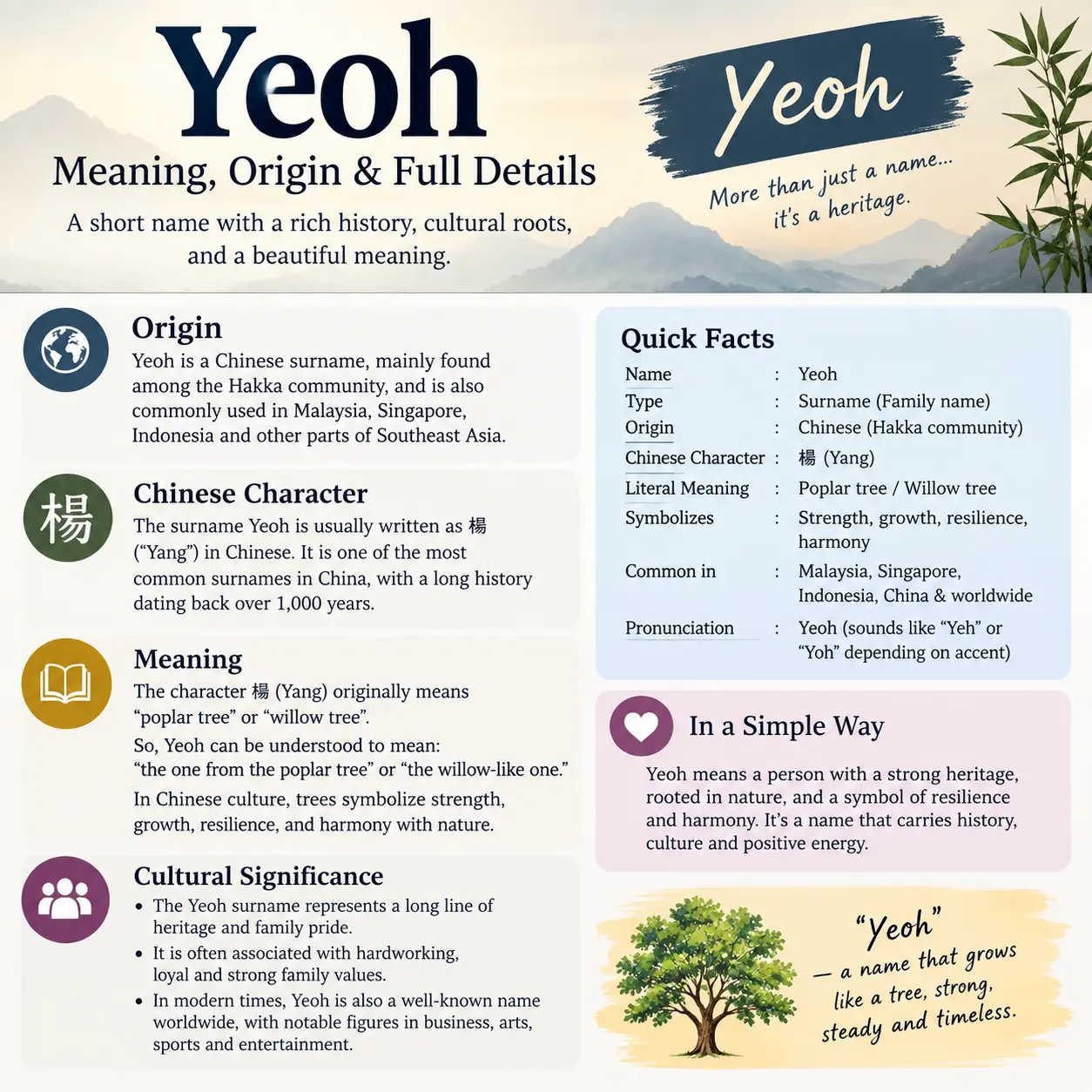
Yeoh Meaning: Origin, Definition, Pronunciation, and Cultural Significance
The yeoh meaning is most commonly connected to a Chinese surname, particularly the surname Yeoh Meaning used among Chinese communities in Malaysia, Singapore, and other parts of Southeast Asia. Like many Chinese surnames, Yeoh Meaning can have different Chinese characters, pronunciations, and historical origins depending on the family and dialect tradition.
Understanding the meaning of Yeoh Meaning requires looking beyond a simple English dictionary definition. It is generally a surname rather than an ordinary English word, and its interpretation can vary according to the Chinese character represented by the spelling. The spelling “Yeoh” is especially associated with Cantonese, Hokkien, Hakka, and other Chinese dialect traditions found throughout Southeast Asia.
This article explains the yeoh meaning, its possible Chinese origins, pronunciation, cultural background, and why the surname appears in several different forms.
Yeoh Meaning and Definition
The word Yeoh is primarily recognized as a Chinese family name or surname. It is not normally used as an English vocabulary word with a single dictionary definition.
The meaning of Yeoh Meaning depends on the Chinese character behind the Romanized spelling. Chinese surnames were historically written using Chinese characters, while spellings such as Yeoh developed when those names were written using the Latin alphabet.
This is important because the same English spelling can sometimes represent different Chinese characters. Similarly, the same Chinese surname may be spelled differently in English depending on the dialect and romanization system used by a family.
For people researching the yeoh meaning, the most useful starting point is therefore to identify the original Chinese character associated with the particular family.
Yeoh as a Chinese Surname
Yeoh is particularly familiar as a surname among Chinese communities in Southeast Asia. It can be encountered in Malaysia and Singapore, where different Chinese dialect groups historically developed their own systems for representing Chinese names in English.
The spelling can preserve information about a family’s linguistic or regional background. A surname written as Yeoh Meaning may therefore reflect the dialect tradition used by earlier generations when the family name was recorded in Roman letters.
Quick Facts
| Feature | Information |
|---|---|
| Name | Yeoh |
| Category | Chinese surname |
| Common region | Southeast Asia |
| Particularly associated with | Malaysia and Singapore |
| Language background | Chinese dialect and romanization traditions |
| Meaning | Depends on the original Chinese character |
| English dictionary word | Generally no |
| Usage | Primarily a family name |
| Related spellings | May vary according to dialect and romanization |
| Cultural context | Chinese communities and Southeast Asian Chinese heritage |
Where Does the Yeoh Surname Come From?
The history of the Yeoh Meaning surname is connected to Chinese naming traditions and the migration of Chinese communities throughout Asia. Chinese families have historically moved between different regions of China and other parts of Asia for trade, employment, education, and family reasons.
When Chinese immigrants settled in Southeast Asia, their names were often recorded by colonial governments, schools, businesses, religious organizations, and other institutions. Different officials and communities used different systems for converting Chinese names into Roman letters.
This contributed to the variety of spellings seen today.
Yeoh in Malaysia
Malaysia is one of the places where the surname Yeoh is especially recognizable. Chinese Malaysians come from several linguistic and cultural backgrounds, including Hokkien, Cantonese, Hakka, Teochew, Hainanese, and other communities.
Because different dialect groups historically used different pronunciation systems, a Chinese surname could acquire a spelling that looks very different from its Mandarin-based spelling.
The surname Yeoh Meaning is therefore an example of how Southeast Asian Chinese naming practices can preserve older regional pronunciations.
Yeoh in Singapore
The surname is also found among Chinese Singaporeans. Singapore’s Chinese population has historically included people from numerous parts of southern China, and different dialect groups contributed to the country’s cultural and linguistic landscape.
As a result, surnames written in English can reflect older dialect pronunciations rather than modern Mandarin pronunciation.
What Does Yeoh Mean in Chinese?
There is no single answer to the question “What does Yeoh mean in Chinese?” without knowing the specific Chinese character.
Chinese surnames are character-based. Each character has its own meaning, history, and pronunciation. A Romanized spelling such as Yeoh does not always provide enough information to identify the exact character.
For example, a family may know its surname in Chinese characters even though it is written as Yeoh in English documents. Another family with a similar Romanized spelling could potentially have a different Chinese character.
This means that translating Yeoh directly into one English word can be misleading.
Why the Chinese Character Matters
Chinese characters contain the historical and linguistic information needed to determine the precise meaning of a surname.
The English spelling is only a representation of the pronunciation. It does not necessarily preserve the complete meaning of the original character.
For genealogical research, family records, ancestral documents, Chinese-language certificates, or information from older relatives can therefore be more useful than an English spelling alone.
How Is Yeoh Pronounced?
The pronunciation of Yeoh can vary depending on the family’s dialect and linguistic background.
A Romanized spelling is not always a precise pronunciation guide for English speakers. The pronunciation may reflect a southern Chinese dialect rather than Mandarin Chinese.
In English-speaking environments, people with the surname may also pronounce their name according to the pronunciation traditionally used by their family.
This is one reason it is better to ask the individual how they pronounce their surname instead of assuming that every person named Yeoh uses exactly the same pronunciation.
Yeoh and Chinese Dialects
Chinese is not a single spoken system with one historical pronunciation. Various regional varieties and dialects have their own pronunciation traditions.
Names that were historically written according to Cantonese, Hokkien, Hakka, or other systems can therefore look very different from their Mandarin pinyin equivalents.
The spelling Yeoh is an example of this broader phenomenon.
Why Are Chinese Surnames Spelled Differently?
Chinese surnames can have multiple English spellings because there is no single historical romanization system that was used everywhere.
Modern Mandarin commonly uses pinyin, but many Southeast Asian Chinese families preserve older spellings based on dialect pronunciation or historical documents.
A family may retain a particular spelling for generations even when its members speak Mandarin or English.
This is why a surname’s spelling can sometimes provide clues about migration history and family heritage.
Yeoh and Genealogy
People researching their family history may encounter the surname Yeoh in immigration records, birth certificates, marriage documents, school records, newspapers, business documents, or cemetery records.
Older records can contain different spellings of the same family name. A researcher should therefore avoid assuming that two spellings represent completely unrelated families.
Researching the Yeoh Family Name
A useful genealogy process includes:
- Identifying the original Chinese characters if possible.
- Asking older family members about ancestral locations.
- Checking historical documents for alternative spellings.
- Comparing dialect-based and Mandarin-based pronunciations.
- Recording both the Chinese characters and Romanized spelling.
- Looking at migration records where available.
This approach can provide a much clearer picture than relying on the English spelling alone.
Famous People With the Surname Yeoh
The surname Yeoh is internationally recognizable partly because of prominent public figures who carry it.
One of the best-known examples is Malaysian actress Michelle Yeoh, whose international film career has brought significant global attention to the surname.
Her career includes major productions in Asian and international cinema, helping make the surname familiar to audiences who may not otherwise have encountered the spelling.
However, the presence of a famous person with the surname does not determine its linguistic meaning. Yeoh remains a surname with a broader cultural and historical background.
Yeoh Meaning in Modern Culture
Today, Yeoh Meaning can be encountered in many different settings, including business, entertainment, education, academia, sports, and everyday life.
People with the surname may live in Malaysia, Singapore, the United Kingdom, the United States, Australia, Canada, and other countries. Global migration has made many traditional Chinese surnames increasingly international.
For younger generations, the surname can represent both family heritage and a modern multicultural identity.
A person named Yeoh may have Chinese ancestry while growing up in an English-speaking, Malay-speaking, or multilingual environment. Consequently, the cultural identity associated with the surname can be broader than its historical linguistic origin.
Common Questions About Yeoh Meaning
Is Yeoh a Chinese surname?
Yes. Yeoh is primarily recognized as a Chinese surname, particularly among Chinese communities in Southeast Asia.
What does the surname Yeoh mean?
The exact meaning depends on the Chinese character represented by the Romanized spelling. “Yeoh” alone does not always identify one specific Chinese character.
Is Yeoh a Malaysian surname?
Yeoh is strongly associated with Malaysian Chinese communities, although the surname is not exclusive to Malaysia. It can also be found in Singapore and among Chinese communities in other countries.
Is Yeoh a word in English?
Generally, Yeoh is used as a proper name or surname rather than as an ordinary English vocabulary word.
Why does Yeoh have different spellings?
Chinese surnames can be romanized according to different dialects and historical systems. Families may also preserve traditional spellings established by earlier generations.
Google E-E-A-T
| E-E-A-T Factor | How This Article Addresses It |
|---|---|
| Experience | Explains practical considerations when researching the surname and its pronunciation. |
| Expertise | Separates Chinese characters, dialect pronunciation, and Romanized spelling rather than treating them as identical. |
| Authoritativeness | Presents the surname within the broader historical context of Chinese naming and Southeast Asian Chinese communities. |
| Trustworthiness | Avoids assigning one definitive meaning where the original Chinese character is unknown. |
Final Thoughts on Yeoh Meaning
The yeoh meaning is best understood through Chinese surname and naming traditions rather than as a simple English word. Yeoh is a Chinese family name particularly associated with Southeast Asian Chinese communities, especially in Malaysia and Singapore. Its precise meaning depends on the Chinese character represented by the spelling, while its pronunciation and Romanization can vary according to dialect and family history.
For anyone researching the surname, identifying the original Chinese character is the most reliable way to determine its specific meaning and historical background. The spelling Yeoh itself also provides an interesting example of how Chinese names have been preserved and adapted across languages, regions, and generations.
Conclusion
The yeoh meaning is connected to Chinese surname traditions, especially among Chinese communities in Malaysia and Singapore. Its exact meaning can vary depending on the original Chinese character, dialect, and family history. Overall, Yeoh is a surname with a rich cultural and linguistic background that reflects the diverse history of Chinese naming traditions.