Principal vs Principle Meaning: What’s the Difference?
Principal vs Principle Meaning If you have ever paused while writing and wondered whether the correct word is Principal vs Principle Meaning, you are definitely not alone. These two words look and sound very similar, but they have completely different meanings. Because they are homophones in many varieties of English, they are especially easy to confuse in writing.
The good news is that learning the difference does not require memorizing complicated grammar rules. Once you understand what each word means and remember a simple trick, choosing the correct spelling becomes much easier. Principal is commonly used for a person in charge or something that is most important, while principle usually refers to a rule, belief, or basic idea.
In this guide, we will explain the principal vs principle meaning in simple language. You will learn their definitions, common uses, examples, pronunciation, memory tricks, and the situations where people most often make mistakes.
Principal Meaning
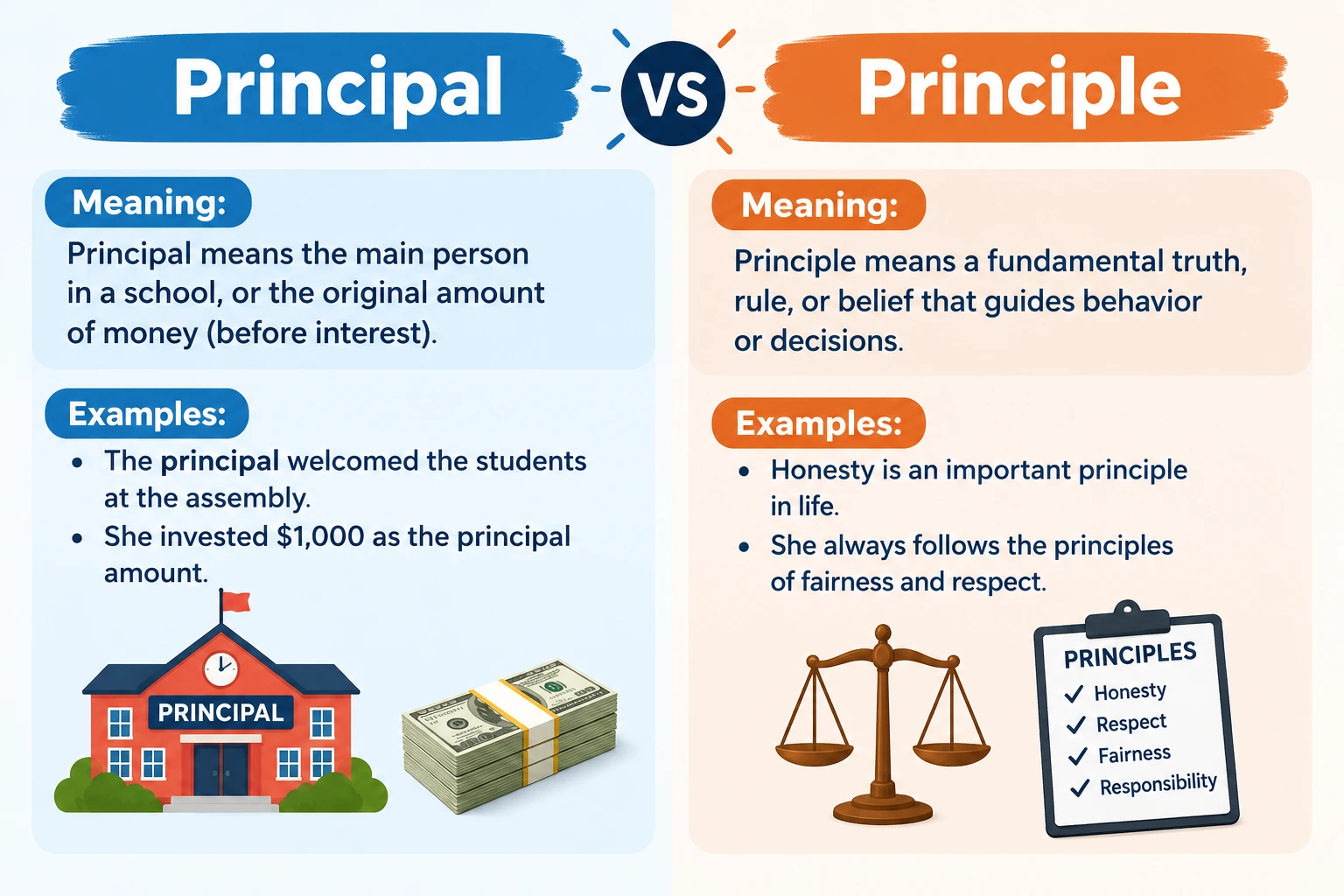
The word Principal vs Principle Meaning has several meanings, but one of its most familiar uses is to describe a person who holds an important position of authority. For example, the head of a school is called a principal. If someone says, “The principal spoke to the students,” they are referring to the person responsible for leading or managing the school.
Principal can also be used as an adjective. In this form, it means main, primary, or most important. For example, in the sentence “The principal reason for the delay was bad weather,” the word principal means the main reason. This meaning is useful in everyday writing because it helps identify the most important person, thing, or factor.
Another important meaning of principal appears in financial language. When people talk about a loan or investment, the principal is the original amount of money borrowed or invested, before interest or other earnings are considered. For example, if you borrow $10,000, that $10,000 is the principal amount of the loan.
Principle Meaning
The word principle is generally used for a rule, belief, standard, or basic idea that guides behavior or thinking. It is often connected to values and the way people decide what is right, appropriate, or important. For example, someone might say, “Honesty is one of my principles.”
Principle can also describe a basic rule or idea behind a system. In science, business, education, and everyday life, principles are often used to explain how something works or what standards should be followed. For example, “The principle of fairness is important in a good workplace” uses principle to describe a guiding standard.
Unlike principal, the word principle does not normally refer to a person in charge or the original amount of money in a loan. When you are talking about beliefs, rules, standards, or fundamental ideas, principle is usually the word you need.
Principal vs Principle: The Main Difference
The easiest way to understand the difference is to focus on their meanings rather than their pronunciation. Principal usually refers to a person, something that is most important, or the original amount of money involved in a financial transaction. Principle refers to a rule, belief, value, or fundamental idea.
For example, consider the sentence, “The principal of the school announced a new policy.” Here, principal refers to a person. If you wrote “The principle of the school,” the meaning would change and the sentence would no longer mean that the school leader made the announcement.
Now consider the sentence, “She refused to compromise her principles.” Here, principles means personal beliefs or moral standards. Writing “principals” would be incorrect because the sentence is not talking about school administrators or important people.
The distinction becomes easier when you connect each word with a memory clue. Principal has the word pal inside it: principal does not literally contain “pal” as a separate word, but many learners use the phrase “the principal is your pal” as a spelling reminder. For principle, think about rules and beliefs. A principle is something that can guide your actions or decisions.
Principal as a School Leader
One of the most common uses of principal is for the head or leader of a school. The principal generally has responsibilities related to students, teachers, administration, policies, and the overall operation of the school.
For example, you might write, “The school principal met with the parents after the meeting.” In this sentence, principal is a noun because it identifies a person. This is probably the use that causes the most confusion because people sometimes accidentally spell it as principle.
A useful way to remember this meaning is the classic phrase “The principal is your pal.” It is a simple mnemonic rather than a grammar rule, but it can be helpful when you are writing quickly. If you are referring to a school leader, use principal.
Principal as “Main” or “Most Important”
Principal does not always refer to a person. It can also be an adjective meaning main, primary, or most important. This use appears frequently in formal and professional writing.
For example, “The principal objective of the project is to improve customer service” means that improving customer service is the main objective. Similarly, “The principal cause of the problem was a software error” means the software error was the main cause.
In these situations, principle would be incorrect. The sentence is not discussing a rule or belief. Instead, it is identifying something as the primary or most important factor. This distinction is particularly useful when writing essays, reports, business documents, and academic content.
Principal in Finance
Another important use of principal occurs in banking and personal finance. The principal is the original amount of money borrowed, lent, or invested.
Suppose you take out a $20,000 loan. The original $20,000 is the principal. Interest may then be charged based on that amount, depending on the terms of the loan. As you make payments, part of each payment may go toward reducing the principal and part toward interest.
The word principle should not be used in this financial context. If you are discussing the amount of money involved in a loan or investment, principal is the correct spelling. Remember: financial principal refers to the original amount, while principle refers to a rule, belief, or fundamental idea.
Principle as a Rule or Belief
The word principle is commonly used when discussing personal values. Someone might say, “She believes strongly in the principle of fairness.” This means fairness is viewed as a guiding value or standard.
Principles can be personal or shared by a group. A person may have principles about honesty, responsibility, respect, or fairness. A company may have principles that influence how it treats customers and employees. A professional organization may also establish principles that guide its members.
When you can replace the word with rule, belief, standard, or guiding idea, principle is often the correct choice. This simple substitution test can help you distinguish it from principal.
Principle in Science and Everyday Life
Principle is also frequently used to describe a fundamental idea explaining how something works. You may see this word in scientific, technical, educational, and professional writing.
For example, someone might discuss a basic principle of physics or a principle of design. In these cases, the word refers to an underlying concept or rule rather than a person. The exact meaning depends on the subject, but the central idea remains the same: a principle provides a foundation or guideline.
In everyday conversation, people may also use principle to describe an idea they consider important. For example, “As a matter of principle, he always keeps his promises.” Here, the word expresses a personal standard that influences behavior.
Common Examples of Principal vs Principle
Understanding examples can make the difference much clearer. Consider these sentences:
- The principal welcomed the new students.
Here, principal means the head of a school. - The principal reason for the change was cost.
Here, principal means the main or most important reason. - The bank calculated the interest on the principal.
Here, principal means the original amount of money. - Honesty is an important principle.
Here, principle means a guiding value or belief. - The company operates according to several important principles.
Here, principles means rules or standards. - She refused to act against her principles.
Here, principles refers to personal beliefs or moral standards.
These examples show why simply relying on pronunciation is not enough. The correct spelling depends on the meaning of the word in the sentence.
A Simple Trick to Remember the Difference
One of the easiest memory tricks is to associate principal with person, primary, or principal amount. If you are talking about a school leader, the main thing, or money borrowed or invested, principal is likely correct.
For principle, think rule or belief. If the word describes a standard, value, idea, or rule that guides people or explains something, use principle.
Another useful question is: Can I replace this word with “rule” or “belief”? If yes, you probably need principle. If you can replace it with “main,” “school leader,” or “original amount,” you probably need principal.
With regular practice, this distinction becomes almost automatic. Instead of trying to remember a complicated spelling rule, focus on what the word is actually doing in the sentence.
Principal vs Principle in a Sentence
The two words can even appear in the same sentence, which makes the difference especially clear. For example: “The school principal explained the importance of following the school’s principles.”
In this sentence, principal refers to the school leader, while principles refers to the rules or values that guide the school community. Although the words look and sound similar, they perform completely different jobs.
Another example could be: “The principal objective of the policy is to protect the principle of equal treatment.” Here, principal means “main,” while principle refers to a fundamental value or standard.
These examples are useful because they demonstrate that context determines which word is correct. Learning the meanings is much more effective than simply memorizing the spellings.
Common Mistakes With Principal and Principle
A common mistake is writing principle when referring to a school administrator. For example, “The principle called a meeting” is incorrect if the writer means the head of the school. The correct sentence is “The principal called a meeting.”
Another frequent mistake occurs when people use principal when talking about moral beliefs. For example, “He refused to lie because of his principals” is incorrect. The correct spelling is “He refused to lie because of his principles.”
Financial writing can create another source of confusion. When referring to the original amount of a loan, the correct word is principal. Saying “loan principle” is a spelling error when the intended meaning is the original borrowed amount.
Quick Comparison
| Word | Main Meaning | Common Use | Example |
|---|---|---|---|
| Principal | School leader | Education | The principal addressed the students. |
| Principal | Main or primary | General writing | The principal reason was cost. |
| Principal | Original amount of money | Finance | The payment reduced the principal. |
| Principle | Rule or belief | Values | Honesty is an important principle. |
| Principle | Fundamental idea | Science/general use | The system follows a basic principle. |
Google E-E-A-T
| E-E-A-T Factor | How This Article Supports It |
|---|---|
| Experience | Uses practical examples and common writing situations to explain the distinction. |
| Expertise | Separates the grammatical and contextual meanings of both words. |
| Authoritativeness | Provides structured definitions, comparisons, and examples focused on standard English usage. |
| Trustworthiness | Avoids presenting the two words as interchangeable and clearly explains their different meanings. |
Principal vs Principle Data
| Feature | Principal | Principle |
|---|---|---|
| Part of Speech | Noun and adjective | Noun |
| Common Meaning | School leader, main, original amount | Rule, belief, standard, fundamental idea |
| Refers to a Person? | Yes, in school context | No |
| Used in Finance? | Yes | No |
| Used for Moral Values? | No | Yes |
| Example | The principal called a meeting. | Honesty is a principle. |
| Memory Clue | Person, primary, principal amount | Rule or belief |
Final Thoughts on Principal vs Principle Meaning
The difference between principal and principle becomes much easier once you focus on meaning. Principal can refer to a school leader, something that is main or most important, or the original amount of money in a financial transaction. Principle, on the other hand, refers to a rule, belief, standard, or fundamental idea.
If you are talking about a person, primary matter, or financial amount, think principal. If you are talking about a rule, value, belief, or basic idea, think principle.
The words may sound almost identical, but their meanings are quite different. Remembering that simple distinction will help you avoid one of the most common spelling mistakes in English and make your writing clearer and more professional.
Conclusion
Understanding the difference between principal and principle is simple once you focus on their meanings. Principal can mean a school leader, something that is most important, or the original amount of money in a loan or investment. Principle refers to a rule, belief, value, standard, or basic idea that guides people or explains how something works.
A quick way to remember the difference is to think of principal as “person, primary, or money” and principle as “rule or belief.” With this simple distinction, you can choose the correct word confidently in everyday writing, school assignments, professional documents, and online content.