Audio Displayed Meaning: What Does “Audio Displayed” Mean?
Audio Displayed Meaning If you have recently seen the phrase “audio displayed” or “audiodisplayed” in a chat, app, transcript, website, or digital interface, you may be wondering what it actually means. The phrase can look like a special notification or technical status, especially when it appears without spaces as “audiodisplayed.”
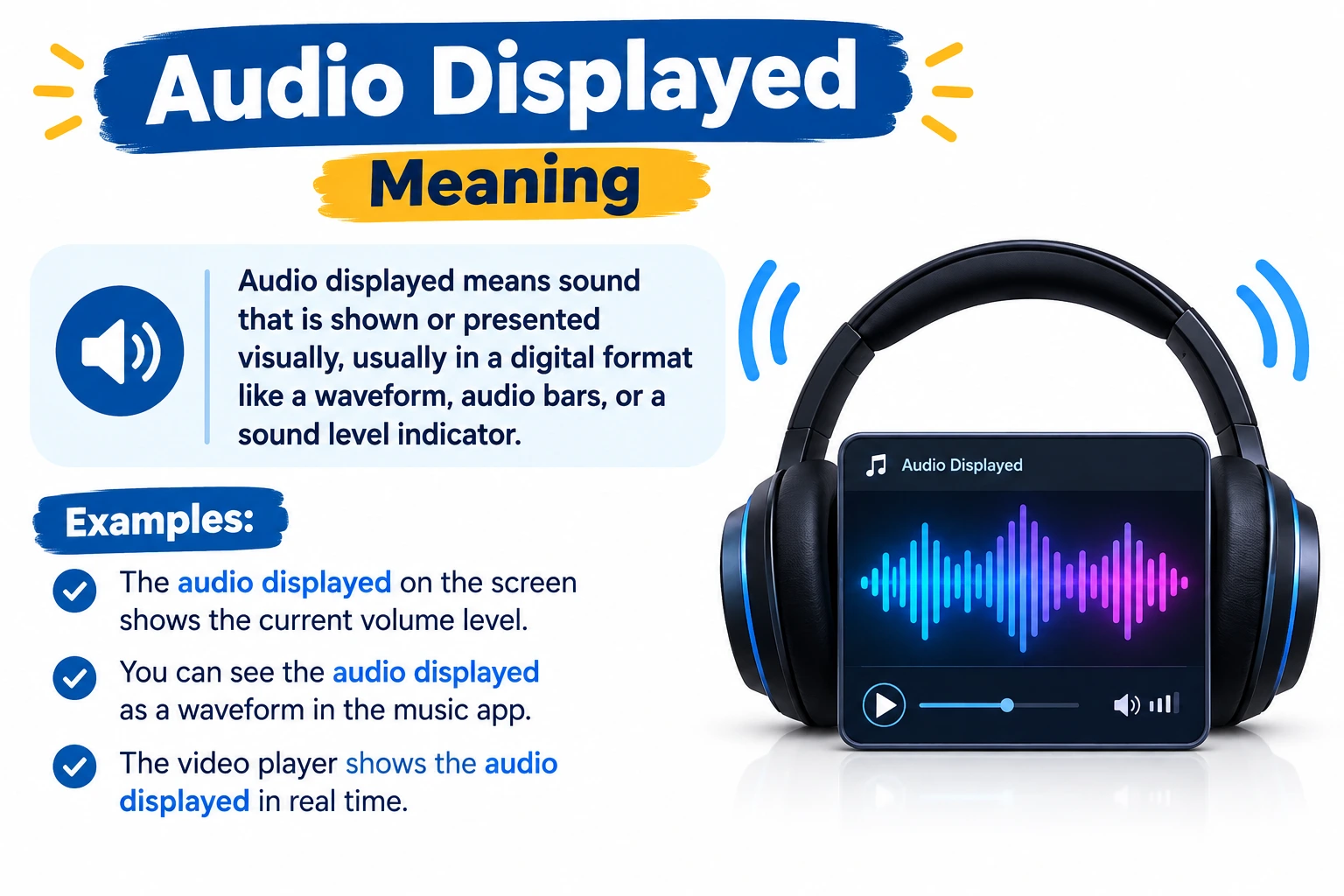
The simplest audio displayed meaning is that an audio element has been shown, presented, or represented on a screen. This could be a voice message, audio player, sound file, waveform, music track, or another audio-related element. The important point is that displayed usually describes visibility, not playback.
This distinction is important because seeing an audio element does not necessarily mean that someone listened to it. A person can see an audio message or player without pressing the play button. Therefore, “audio displayed” should not automatically be interpreted as “audio played” or “audio listened to.”
Quick Data About Audio Displayed Meaning
| Data | Details |
|---|---|
| Keyword | Audio displayed meaning |
| Common form | Audio displayed |
| Joined form | Audiodisplayed / audioDisplayed |
| Basic meaning | Audio content or an audio element was shown |
| Category | Digital/audio terminology |
| Common context | Apps, chats, transcripts, websites, software |
| Does it prove playback? | No |
| Does it prove someone listened? | No |
| Standard slang? | No fixed slang meaning |
| Meaning depends on context? | Yes |
What Does Audio Displayed Mean?
The phrase “audio displayed” can be understood by looking at its two parts. “Audio” refers to sound, such as music, speech, voice recordings, podcasts, or sound effects. “Displayed” means something has been shown, presented, or made visible through an interface.
When these words are combined, the natural interpretation is that an audio-related element appeared on the screen. For example, a website may display an audio player containing a play button, progress bar, and volume control. The audio is visible and available, but that does not mean playback has started.
The same idea can apply to a messaging application. If a voice message appears as an audio bubble or player inside a conversation, the system may describe that event as audio being displayed. The exact technical label depends on the application, but the general concept remains the same: the audio element was presented to the user.
It is also important to understand that “audio displayed” is not generally recognized as a common texting abbreviation like “LOL,” “BRB,” or “IDK.” Current explanations of the term generally treat it as ordinary descriptive language, a technical label, or a system-generated marker rather than established internet slang.
Is “Audiodisplayed” a Real English Word?
Audiodisplayed is not standard everyday English. In normal writing, the clearer form is “audio displayed”, with a space between the two words. The joined version can appear because software, databases, transcripts, URLs, or programming systems often remove spaces from labels and identifiers.
For example, a developer might create an internal variable called audioDisplayed. This follows a common programming style called camelCase, where the first word begins with a lowercase letter and the next word begins with a capital letter. A different system might use audio_displayed, while an interface could simply show “Audio Displayed.”
This explains why the phrase may look unusual when you encounter it online. A technical system does not always use natural conversational English for its internal labels. Sometimes those labels become visible through an exported transcript, debugging screen, analytics report, or copied text.
So, if you are writing an article, message, or normal sentence, “audio displayed” is generally more natural. If you are describing an exact software field or system identifier, however, preserving the original spelling such as audioDisplayed may be appropriate.
What Does Audio Displayed Mean in a Chat or Message?
When “audio displayed” appears in a chat or exported conversation, it may indicate that an audio item was represented at that point in the conversation. For example, a text export may not contain the actual voice recording, so the system could insert a marker indicating that audio existed there.
Imagine a conversation containing a voice message. Instead of showing the original recording in a text-only export, the exported file might contain something resembling “AudioDisplayed.” In that situation, the label can function as a placeholder for the missing or separately stored audio content.
However, you should be careful about reading too much into the label. It does not automatically tell you whether the recipient pressed play, listened to the recording, downloaded it, or heard the complete message. Those are separate actions that may be tracked independently by different platforms.
This is one of the biggest reasons people search for audio displayed meaning. They may see the phrase and assume it is a type of read receipt. In reality, there is no universal rule saying that “audio displayed” means another person listened to a voice message. The surrounding application and its own terminology are necessary to determine the exact meaning.
Does Audio Displayed Mean Someone Listened to the Audio?
No. “Audio displayed” by itself does not prove that someone listened to an audio recording.
There is a major difference between an audio element being visible and audio playback actually taking place. A player can appear on a screen before a user presses play. Similarly, a voice message can appear in a conversation while the recipient chooses not to open or play it.
For example, imagine that you send someone a 60-second voice message. The audio message becomes visible in their conversation. That could be described as the audio being displayed. If they then press the play button, the system may record a separate playback event. If they listen until the end, another event may potentially record completion.
These stages should not be confused. Displayed means presented or visible, while played refers to playback. Even playback itself does not necessarily prove that a person listened attentively to every second, because technical playback and human attention are not identical things.
Audio Displayed vs. Audio Played
The difference between these phrases is simple but important. Audio displayed generally concerns the presentation of an audio element, while audio played concerns the start or occurrence of playback.
Suppose a website contains an embedded podcast. When the page loads, the podcast player can become visible. At this point, the audio is displayed. The visitor might scroll away without touching the player. Nothing about the visible player proves that the podcast was played.
If the visitor presses play, that is a different event. The browser or application can recognize that playback has started. This is why technical systems often distinguish between rendering a media element and actually playing it.
The same distinction can apply to voice messages. An audio bubble appearing in a conversation is not necessarily equivalent to the recipient listening to it. A platform may have separate indicators for delivery, opening, playback, and completion, although the exact terminology differs from one service to another.
Comparison Related Audio Terms
| Term | General Meaning | Proves Someone Listened? |
|---|---|---|
| Audio displayed | Audio element was shown or represented | No |
| Audio delivered | Audio content reached its destination | No |
| Audio opened | Audio-related message or interface was opened | Not necessarily |
| Audio played | Playback started | Not necessarily |
| Audio completed | Playback reached completion | Stronger playback evidence, but context matters |
| Original sound | Audio associated with a creator or recording | No |
Where Might You See “Audio Displayed”?
One possible place is a chat or messaging environment. Some systems represent voice messages differently from ordinary text. When conversations are exported, copied, or converted into another format, the original audio may be replaced by a text marker.
Another possibility is a website or media player. A website can display an audio player even when the user has not started playback. In this situation, “audio displayed” is simply a description of the media interface appearing on the page.
The phrase can also appear in technical environments, including software logs, analytics dashboards, database fields, developer tools, and internal event tracking. Product teams sometimes record events such as when a media component becomes visible. A label based on that event may later appear as audioDisplayed or another similar format.
There is also the possibility of a simple formatting issue. When information moves between systems, spaces may disappear. Therefore, “audio displayed” can become “audiodisplayed” even though the original phrase contained two separate words.
Why Does Audio Displayed Sometimes Appear as One Word?
The joined spelling can look confusing because standard English normally separates the words. However, digital systems frequently create compact names for events and fields.
A programming system might use audioDisplayed because spaces are not allowed in many identifiers. Another system may use audio_displayed, while a database could store the same idea under a custom field name.
Text extraction can create another problem. When content is copied from a digital interface, formatting may not always survive. A phrase that originally appeared as “Audio Displayed” could end up appearing as “AudioDisplayed” or “audiodisplayed.”
This means the spelling itself is not enough to determine the meaning. The context is more important than whether the phrase contains a space. If it appears in code, it may be a variable or event name. If it appears in a transcript, it may be a placeholder. If it appears in ordinary English, it may simply mean that an audio element was shown.
What Audio Displayed Does Not Mean
One of the easiest mistakes is assuming that “audio displayed” has a more specific meaning than the available evidence supports. The phrase does not have one universal definition across every application, website, or messaging platform.
For example, seeing “audio displayed” does not automatically mean that a person listened to a recording. It also does not necessarily mean that the audio was downloaded, saved, shared, or completed. Those actions require separate evidence from the platform involved.
It also should not automatically be treated as a secret abbreviation or emotional expression. Unlike established internet slang, the phrase generally functions as a descriptive or technical label. Several current explanations of the term emphasize that its exact interpretation depends on where it appears.
If you are trying to understand a particular notification, screenshot, transcript, or app message, the best approach is to look at the surrounding words and identify the platform that generated it. That information can make the interpretation much more precise.
Google E-E-A-T
| E-E-A-T Factor | How This Article Addresses It |
|---|---|
| Experience | Explains common situations involving audio interfaces, chats, transcripts, and digital media |
| Expertise | Separates display, playback, delivery, and completion instead of treating them as the same event |
| Authoritativeness | Uses contextual explanations and distinguishes standard English from technical naming conventions |
| Trustworthiness | Avoids claiming that “audio displayed” proves someone listened to an audio message |
| Accuracy | Notes that the exact meaning can depend on the platform or system where the phrase appears |
Frequently Asked Questions About Audio Displayed Meaning
What is the simplest audio displayed meaning?
The simplest meaning is that an audio element has been shown or represented in a digital interface. It could be a voice message, audio player, recording, waveform, or another sound-related element.
Does audio displayed mean someone listened to my voice message?
No. The phrase alone does not prove that someone listened to the recording. Displaying an audio element and playing it are separate actions.
Is audiodisplayed slang?
There is no widely established slang definition for “audiodisplayed.” It is more likely to be a technical label, system-generated marker, formatting variation, or joined version of “audio displayed.”
Why is audio displayed written as one word?
Digital systems often combine words when creating programming variables, event names, database fields, or metadata labels. This is why forms such as audioDisplayed or audio_displayed may appear.
What is the difference between audio displayed and audio played?
“Audio displayed” generally refers to an audio element being shown or presented. “Audio played” indicates that playback has started. The first does not automatically prove the second.
Can audio displayed mean a voice message exists?
In some transcript or export contexts, it can function as a marker showing that an audio element existed at that point. However, the exact behavior depends on the system that produced the label.
Conclusion
The audio displayed meaning is relatively simple once the phrase is separated into its two parts. Audio refers to sound content, while displayed refers to something being shown or presented. Together, “audio displayed” generally describes an audio element appearing in a digital interface.
The most important thing to remember is that displayed does not automatically mean played or heard. A voice message, music player, or audio file can be visible without anyone pressing play. That is why “audio displayed,” “audio played,” and “audio completed” should not be treated as identical statuses.
If you see “audiodisplayed” written as one word, it is likely a technical-style label, formatting variation, or system-generated marker rather than a standard English slang term. The exact interpretation ultimately depends on where you found it and how that particular platform uses its audio-related labels.